Introduction
Eon Musk has once again captured the attention of technology enthusiasts with Tesla’s next-generation Roadster, an electric sports car designed to push the boundaries of automotive engineering. Combining Tesla’s electric vehicle technology with SpaceX-inspired propulsion systems, the Roadster introduces an experimental approach to high-performance transportation. Its rocket-style thrusts and specialized aerodynamic systems have generated considerable interest among people following the future of electric and flying cars.
Unlike conventional sports cars that rely entirely on wheels and electric motors for movement, the advanced Roadster concept explores additional propulsion technology that can produce brief aerial maneuvers. However, it is important to distinguish between a vehicle capable of short, controlled lifts and a fully functional flying car designed for everyday air transportation. The Roadster’s final production specifications, flight capabilities, and regulatory approvals remain important considerations.
Tesla Roadster 2026: Design, Engineering, and the Technology Behind the New Sports Car
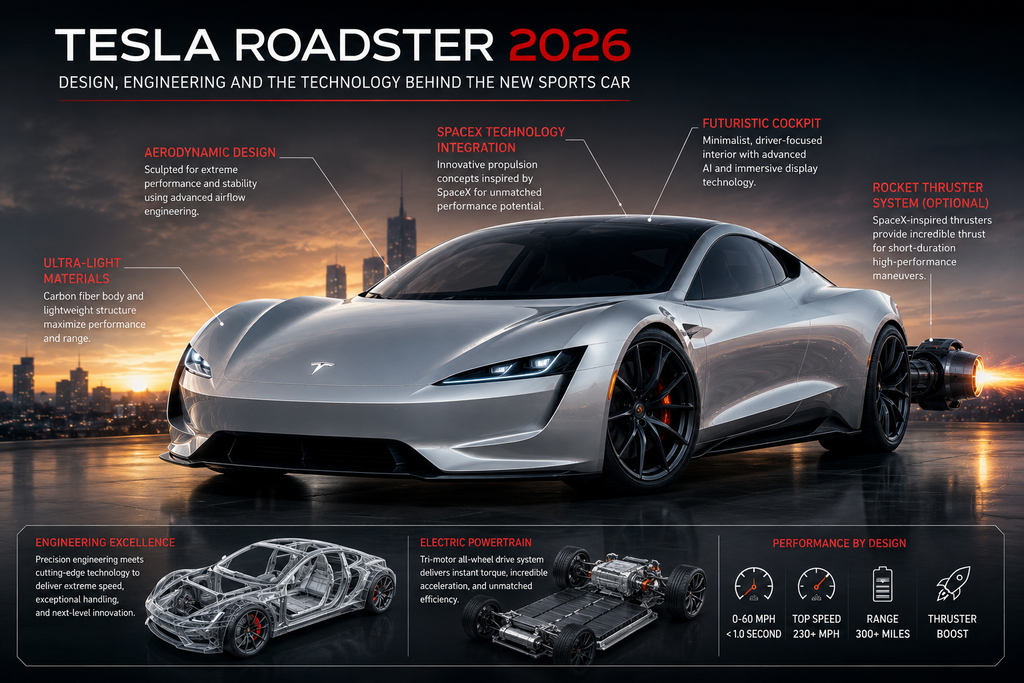
The Tesla Roadster was originally introduced as a next-generation electric sports car intended to deliver exceptional acceleration, high top speed, and an extended driving range. Its development has taken considerably longer than initially anticipated, but its futuristic design continues to attract attention from automotive enthusiasts.
The latest Roadster concept combines the low-profile appearance of a supercargo with engineering ideas inspired by aerospace technology. Its exterior is designed to manage airflow at high speeds, while lightweight materials and advanced structural engineering can help balance performance and vehicle weight.
The most distinctive aspect of the experimental configuration is the integration of SpaceX-inspired thrusts. These devices are intended to provide short bursts of thrust, enabling specialized maneuvers that are not possible with conventional electric motors alone. Nevertheless, this technology does not automatically make the Roadster an aircraft or establish that it can fly safely over public roads.
Tesla’s broader objective is to demonstrate how electric propulsion, advanced materials, aerodynamic engineering, and aerospace-inspired systems might work together in a high-performance vehicle.
Tesla Roadster Engine, Electric Motors, Battery Technology, and SpaceX Propulsion System
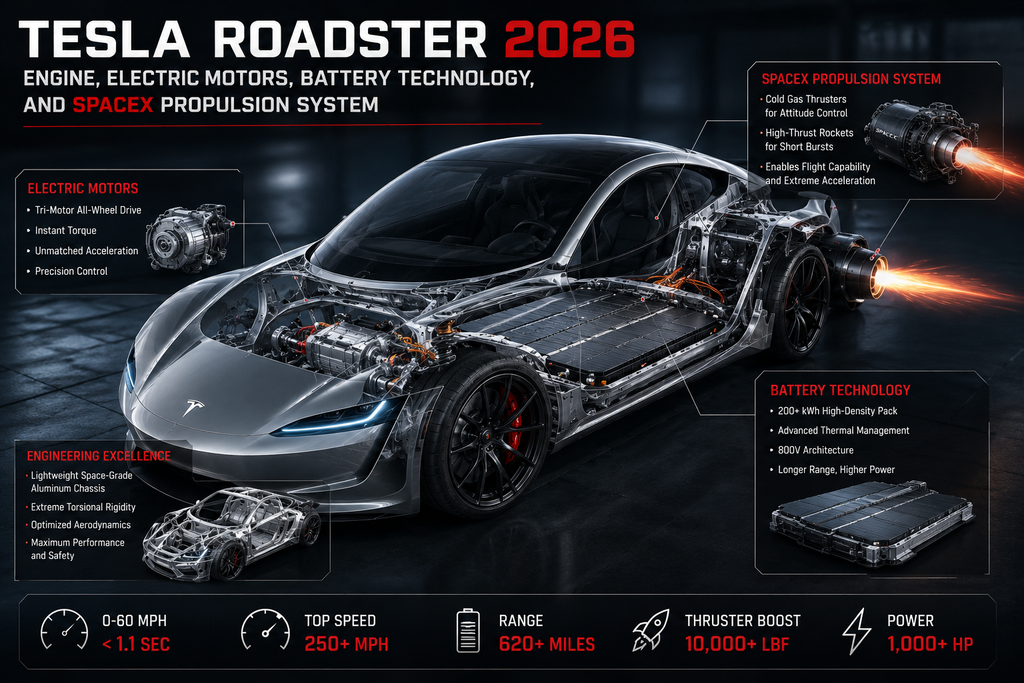
Unlike traditional sports cars powered by petrol engines, the Tesla Roadster uses an electric PowerPoint for normal road driving. Electric motors deliver torque rapidly, helping the vehicle accelerate quickly without relying on conventional internal combustion technology. Its battery pack supplies electrical energy to the motors, although the final production battery capacity, motor configuration, and total power output have not been fully confirmed.
The most unusual engineering feature is the optional SpaceX-inspired propulsion package. Rather than replacing the electric motors, the additional thrusts are intended to provide supplementary thrust for specialized performance demonstrations.
The reported system uses compressed gas stored in high-pressure vessels. When gas exits a nozzle, it produces thrust in the opposite direction. By controlling the direction and timing of thrust, a system can influence a vehicle’s movement. The engineering challenge is making this technology safe, predictable, and practical in a passenger vehicle.
Carbon-fiber-wrapped pressure vessels are associated with aerospace applications because they can store pressurized gas while managing structural weight. Integrating them into a road vehicle requires careful engineering of pressure limits, mounting structures, maintenance procedures, and passenger protection.
The propulsion package should not be confused with a conventional jet engine or a continuously operating rocket engine. Its operating principles and limitations are different, and the final commercial system requires complete technical documentation before its performance can be independently assessed.
Tesla Roadster 2026 Specifications, Technology, and Main Features
The following table summarizes the vehicle’s reported specifications and the technology associated with its advanced configuration. Figures that have not been independently verified or finalized should be treated as reported targets rather than guaranteed production specifications.
| 𝐒𝐩𝐞𝐜𝐢𝐟𝐢𝐜𝐚𝐭𝐢𝐨𝐧 | 𝐑𝐞𝐩𝐨𝐫𝐭𝐞𝐝 𝐃𝐞𝐭𝐚𝐢𝐥𝐬 | 𝐓𝐞𝐜𝐡𝐧𝐨𝐥𝐨𝐠𝐲 𝐨𝐫 𝐏𝐮𝐫𝐩𝐨𝐬𝐞 |
| Vehicle type | Electric sports car | High-performance automotive engineering |
| Road powertrain | Electric motors | Battery-powered propulsion |
| Additional propulsion | Optional SpaceX-inspired thrusters | Short bursts of supplementary thrust |
| Reported top speed | Over 230 mph | High-speed electric performance |
| Reported acceleration | Under 1 second to 60 mph in the advanced configuration | Electric power and claimed thruster assistance |
| Projected driving range | Over 300 miles | Battery-electric driving |
| Gas storage | Reported high-pressure vessels | Compressed-gas propulsion |
| Aerodynamic technology | Advanced aerodynamic design | Airflow management and high-speed stability |
| Special demonstration system | Underside suction technology | Attachment to a specially designed inverted surface |
| Production target | 2028 | Planned production timeline |
| Final retail price | Not confirmed | Depends on the production configuration |
These details describe reported claims and experimental capabilities, not a complete set of independently verified specifications for a production-ready vehicle. Tesla may revise its design, performance targets, and equipment before customer deliveries begin.
Advanced Automotive and Aerospace Technologies That Make the Tesla Roadster Different
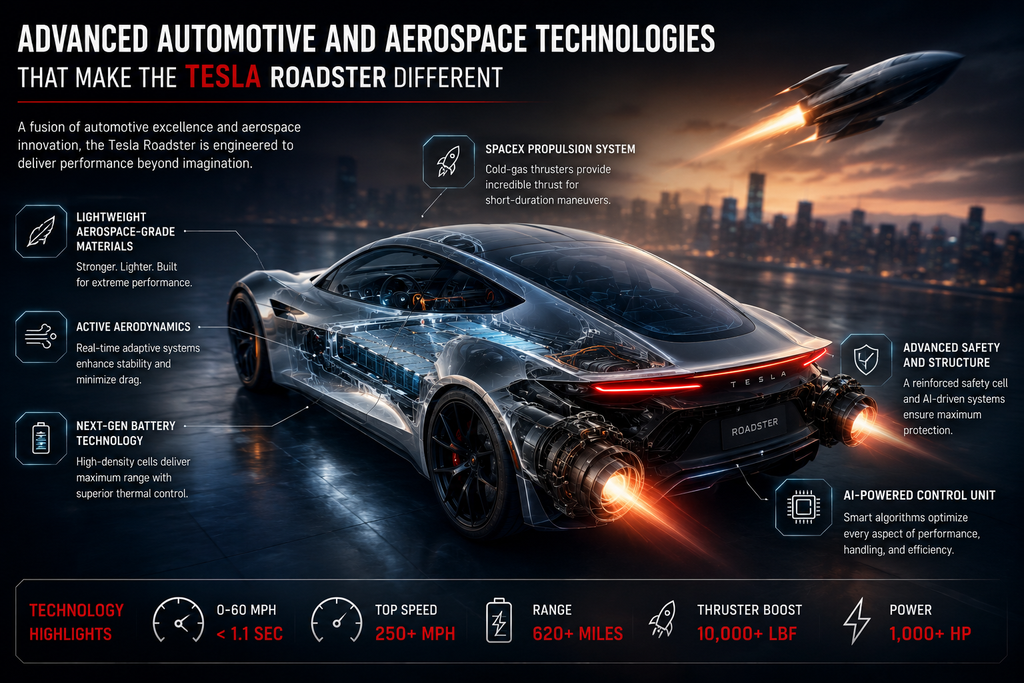
The Roadster’s most interesting feature is its combination of technologies that traditionally belong to different engineering disciplines. Its battery-electric PowerPoint is suited to road driving, while its optional thrusts introduce a separate method of generating force.
The compressed-gas propulsion system is designed to create brief thrust pulses. The carbon-fiber pressure vessels associated with this arrangement must withstand high internal pressure without adding excessive weight. These components require specialized testing and safety measures because a failure in a pressurized system can be dangerous.
The experimental suction system demonstrated on an inverted ramp represents another unusual engineering approach. Fans can create a pressure difference that helps hold a vehicle against a specially prepared surface. This is fundamentally different from magnetic levitation and should not be mistaken for a system that allows a car to float freely above ordinary roads.
Aerodynamics also remain essential. At very high speeds, air resistance increases substantially, making body shape, airflow management, cooling, tyres, braking, and stability critical to performance. Lightweight structural materials can help reduce mass, but their exact use in the final Roadster must be confirmed through production specifications.
Together, these technologies illustrate an ambitious engineering experiment. However, their practical value will depend on reliability, maintenance requirements, safety certification, and the ability to operate outside carefully controlled demonstrations.
Tesla Roadster 2026 Speed, Acceleration, Driving Range, and Battery Performance
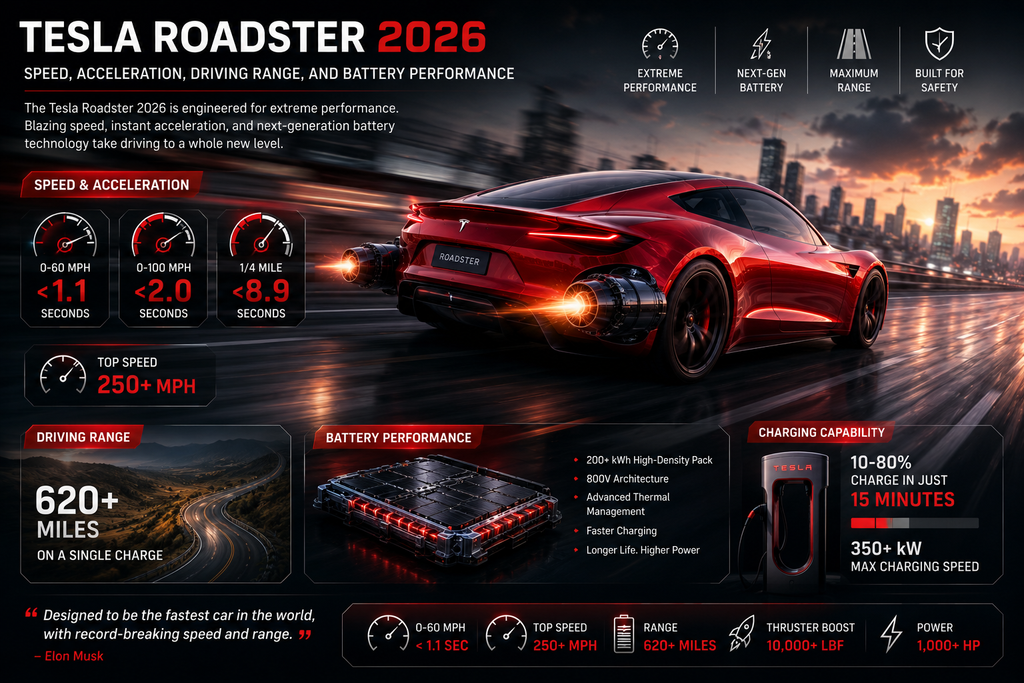
Performance is central to the Roadster’s appeal. Tesla has historically promoted the vehicle as an electric sports car capable of extraordinary acceleration, and the advanced configuration has been associated with a claimed zero-to-60-mph time of less than one second.
That claim requires careful interpretation. The advanced thruster-equipped configuration should not automatically be treated as equivalent to the standard electric-only road vehicle. Actual performance will depend on the final design, testing conditions, tyre grip, surface quality, and the precise configuration used.
The reported top-speed target exceeds 230 mph, equivalent to approximately 370 km/h. At such speeds, the vehicle needs carefully engineered tyres, braking systems, suspension, cooling, and aerodynamic stability.
The projected driving range exceeds 300 miles per charge. Real-world range can vary significantly according to driving speed, weather, temperature, road conditions, battery configuration, and use of auxiliary systems.
Tesla has not confirmed every final production specification, including battery capacity in kilowatt-hours and complete motor-output figures. Until these details are published and independently tested, the reported figures should be treated as performance targets rather than guaranteed results.
Tesla Roadster Models, Expected Price, Production Timeline, and Availability
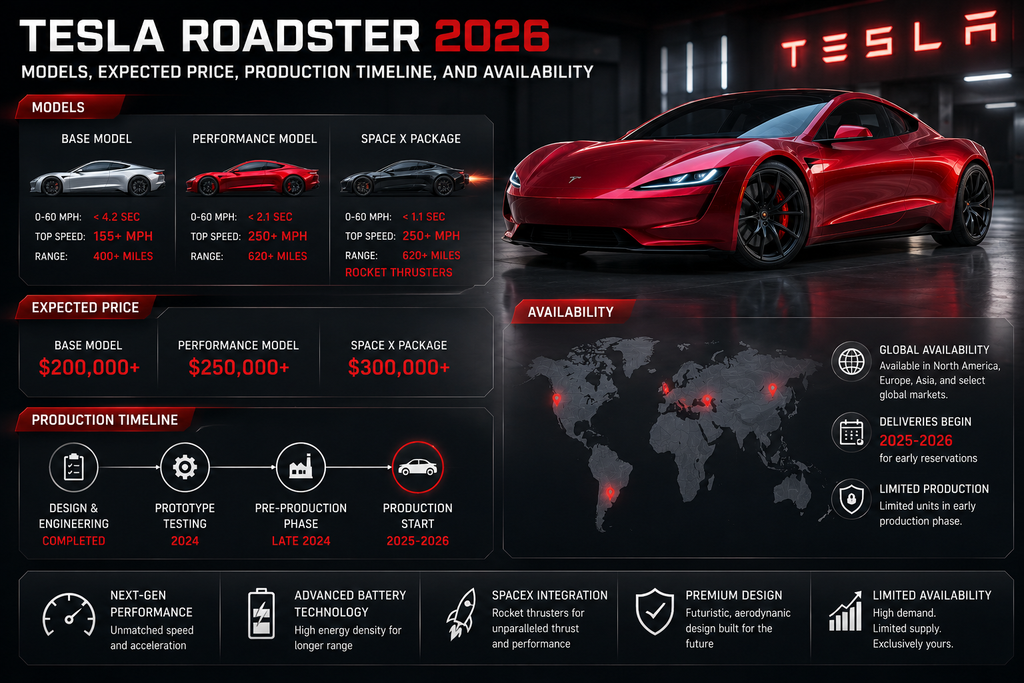
The advanced Roadster has been associated with different configurations aimed at different levels of performance and exclusivity. The Performance configuration is intended primarily for road use, while the Thrust configuration adds specialized propulsion technology. A more experimental Rocket configuration has also been described as a limited-access, single-seat option.
Reported reservation deposits have included $50,000 for the Performance configuration and $250,000 for the Thrust configuration. These amounts represent reported deposits, not confirmed final retail prices. The ultimate cost of the vehicle will depend on its production configuration, included equipment, and final commercial terms.
Tesla has indicated a 2028 production target, but this should not be interpreted as a guaranteed delivery date. The Roadster has experienced development delays in the past, and final production timing depends on engineering validation, manufacturing readiness, and regulatory requirements.
For buyers, the most important consideration is that the vehicle remains a specialized, high-performance product rather than an established form of everyday flying transportation. The final retail price, production quantities, delivery schedule, and regional availability require confirmation from Tesla.
Is the Tesla Flying Roadster a Real Flying Car, and What Does It Mean for the Future?
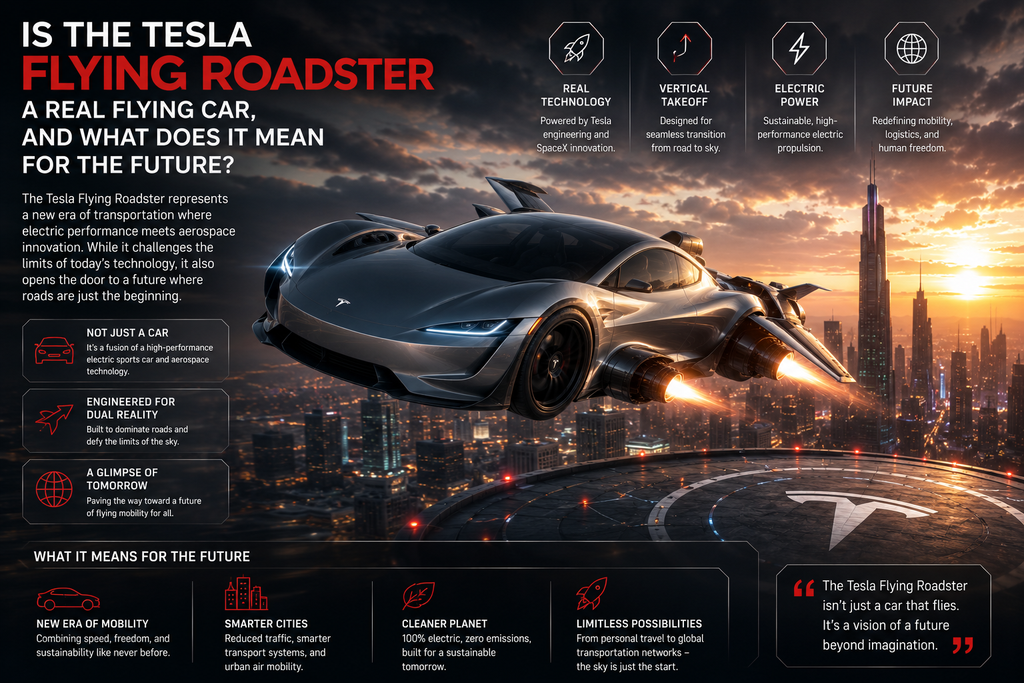
The Roadster’s experimental propulsion technology has raised an important question: can it genuinely be described as a flying car? The answer depends on how the term is defined. A vehicle that performs a short, controlled lift or jump is not necessarily capable of sustained, steerable flight like an aircraft.
A practical flying car would need to demonstrate repeatable flight, reliable control, safe landing procedures, suitable emergency systems, and compliance with the relevant aviation regulations. Operating above public roads would also introduce additional risks for passengers and people nearby.
High-pressure gas storage creates its own safety considerations, while the vehicle’s road-driving systems must continue to satisfy applicable automotive requirements. Any future production model equipped with aerial capabilities would need clear operational limits and appropriate certification before those features could be used legally.
Nevertheless, the Roadster represents an interesting direction for experimental vehicle engineering. Its combination of battery-electric propulsion, aerospace-inspired technology, and high-performance design demonstrates how automotive innovation can draw inspiration from other industries.
For TechLogic readers, the key takeaway is that the Tesla Roadster should be viewed as an ambitious electric sports car with experimental propulsion features, rather than a fully established flying car for everyday transportation. Its long-term significance will depend on whether the technology can become reliable, affordable, safe, and commercially available.
TechLogic Verdict:
Tesla’s next-generation Roadster could become a notable example of the convergence between electric vehicles and aerospace engineering. Its reported speed, acceleration, and thruster technology are exciting, but final production specifications and real-world capabilities must be verified before the vehicle can be judged as a practical flying car.
Final Thoughts
Can Tesla Roadster Redefine the Future of Transportation?Eon Musk’s Tesla Roadster represents an ambitious vision of how electric vehicles could evolve through the integration of automotive engineering and aerospace-inspired technology. Its high-performance electric PowerPoint, experimental rocket thrusts, and futuristic design have generated excitement among technology enthusiasts and automotive fans.
However, the real success of this vehicle will depend on more than impressive demonstrations. Production readiness, passenger safety, regulatory approval, affordability, and reliable everyday performance will determine whether its advanced capabilities become practical innovations or remain experimental features.
For now, the Tesla Roadster offers a fascinating glimpse into the future of high-performance electric transportation. If Tesla can successfully translate its ambitious engineering concepts into a safe and commercially available vehicle, it could open new possibilities for the automotive industry. Until then, its flying-car capabilities should be viewed with realistic expectations.
At TechLogic, we believe the most important question is not simply how fast the Tesla Roadster can go, but how far this combination of electric and aerospace technology can take the future of transportation.
Hashtags
#TeslaRoadster2026 #ElonMusk #TeslaFlyingCar #TeslaRoadster #FlyingCar #SpaceXTechnology #Tesla #ElectricCars #FutureOfTransportation #FlyingCarTechnology #ElectricSportsCar #RocketThrusters #AutomotiveTechnology #FutureCars #TeslaNews #EVTechnology #NextGenerationCars #FuturisticCars #TechNews #TechLogic
Keywords
Tesla Flying Roadster 2026, Eon Musk flying car, Tesla Roadster 2026 features, Tesla flying car technology, Tesla Roadster engine, Tesla Roadster 2026 price, SpaceX rocket thrusts, Tesla Roadster top speed, Tesla Roadster acceleration, Tesla Roadster driving range, Tesla electric sports car, Tesla Roadster release date, flying car technology 2026, Eon Musk new car, future electric cars, SpaceX technology in cars, Tesla Roadster battery, Tesla Roadster specifications, next-generation electric vehicles, rocket-powered electric car, Tesla Roadster production, Tesla Roadster 2026 engine and features, can the Tesla Roadster really fly, Tesla flying car expected price and release date, Tesla Roadster 2026 speed and driving range, SpaceX thruster technology in Tesla Roadster, Eon Musk futuristic electric sports car, Tesla Roadster 2026 full specifications, future of flying cars and electric vehicles, TechLogic.