Introduction
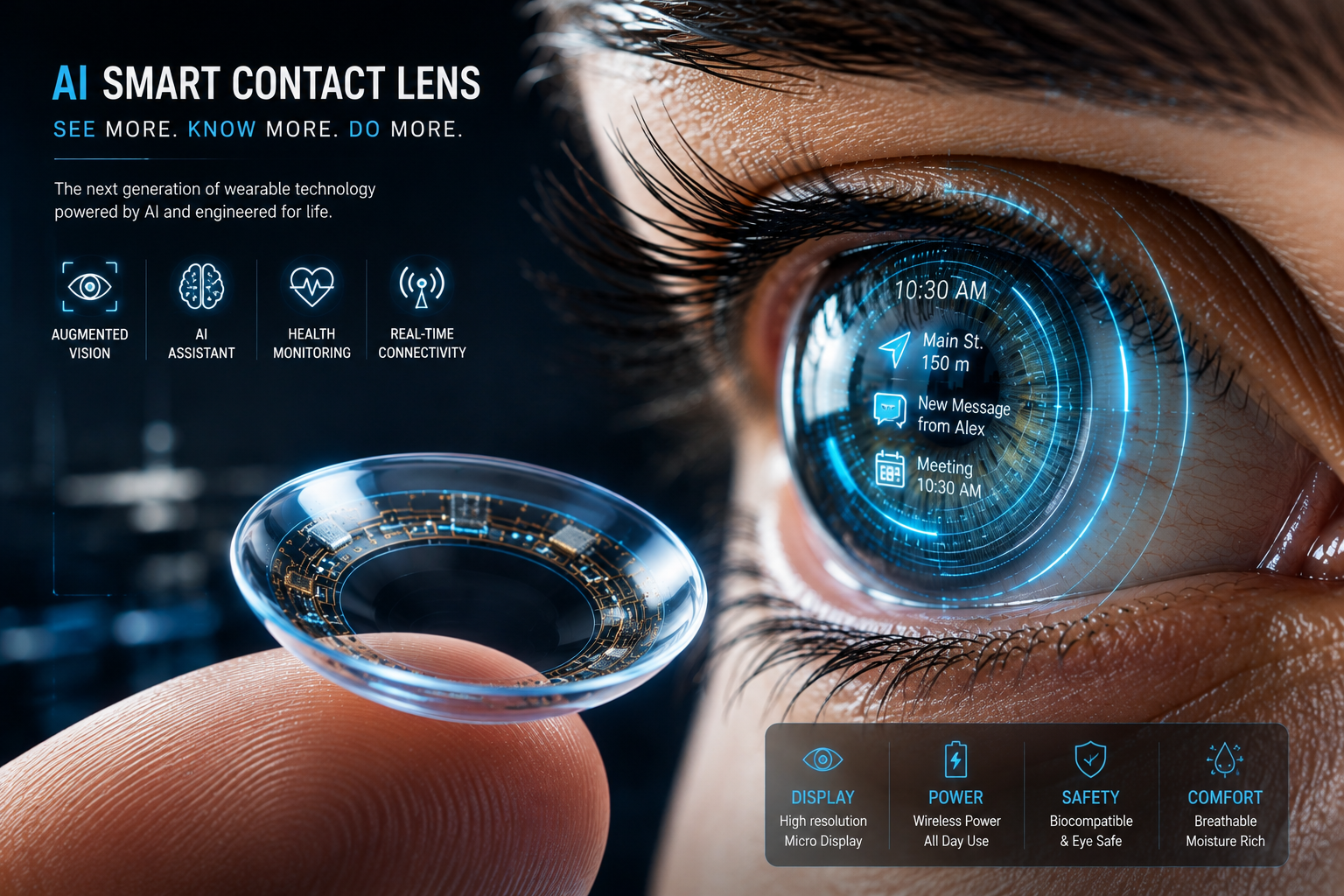
Imagine waking up in 2027, putting a tiny contact lens into your eye, and accessing digital information without picking up your smartphone or wearing smart glasses. You could potentially view navigation directions, receive notifications, access AI-powered assistance, or monitor certain health indicators through technology integrated into a contact lens. Although this sounds like science fiction, researchers and technology companies are actively developing smart contact lenses that combine miniature displays, wireless electronics, sensors, and artificial intelligence. These innovations could introduce an entirely new category of wearable technology, bringing computing closer to the human eye than ever before. However, the technology remains under development, and a fully functional, everyday AI contact lens is not yet a mainstream consumer product.
What Are AI Smart Contact Lenses?
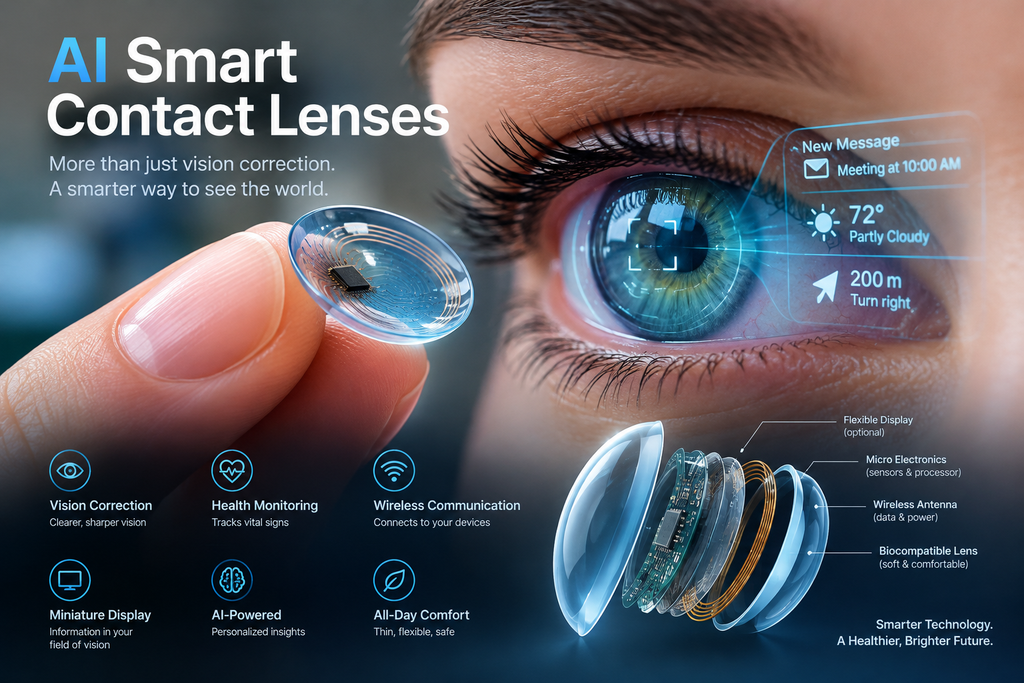
AI smart contact lenses are advanced wearable devices designed to do more than correct vision. Depending on their design, they may incorporate miniature electronic components, optical systems, health-monitoring sensors, and wireless communication technology. Future versions could connect with smartphones or other computing devices to provide information directly within the wearer’s field of vision. Unlike traditional smart glasses, these lenses would sit directly on the surface of the eye, potentially offering a discreet alternative to conventional wearable displays.
The biggest challenge is fitting sophisticated technology into a device that must remain extremely thin, flexible, comfortable, and safe for the eye. Engineers must develop components that consume very little power while producing useful information without interfering with natural vision. Research into flexible electronics, miniature displays, wireless power delivery, and bio compatible materials is helping scientists investigate possible solutions. AI could eventually help interpret sensor data and personalize information, although the lens itself may rely on an external device for much of its processing.
Why 2027 Could Be an Important Year
The year 2027 could represent an important milestone for smart contact lens development. XPANCEO, a company working on advanced smart lens technology, announced in 2026 that it was preparing an integrated prototype combining technologies such as an on-eye display, health monitoring, and wireless power. The company has described plans for a public demonstration in early 2027. These plans indicate progress towards combining several experimental capabilities into a single platform, but they do not guarantee that a consumer-ready product will launch that year.
This distinction matters because building a working prototype is only one stage of product development. A commercially available contact lens must also demonstrate reliable performance, meet strict eye-safety requirements, offer a practical power solution, and undergo appropriate regulatory evaluation. Nevertheless, progress in miniature optical systems and wireless electronics makes 2027 an interesting year to watch for developments in this emerging technology.
Could Smart Contact Lenses Replace Smartphone Screens?
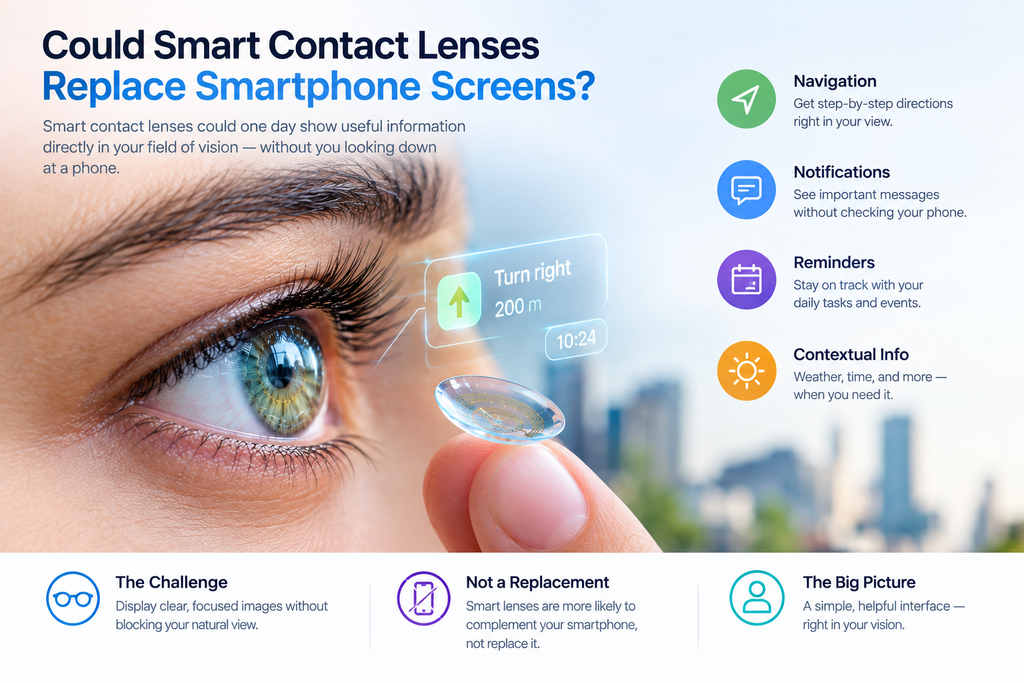
One of the most exciting possibilities is the ability to access selected digital information without looking down at a phone. Future smart lenses might display short notifications, navigation prompts, reminders, or other contextual information directly within the wearer’s vision. Instead of repeatedly checking a screen, users could potentially receive relevant information while walking, working, or performing everyday activities.
However, displaying a useful digital image inside a contact lens is much more complicated than shrinking a smartphone screen. Engineers must carefully control image focus, brightness, optical alignment, and the position of digital content. The technology must also avoid obstructing important parts of a person’s natural field of view. Even if these challenges are solved, smartphones are unlikely to disappear immediately. For the foreseeable future, smart lenses would be more realistically viewed as a complementary interface for selected tasks rather than a complete replacement for conventional displays.
AI-Powered Features That Could Transform Wearable Technology
Artificial intelligence could make future smart contact lenses more useful by interpreting information and delivering relevant assistance. For example, a connected AI system might analyses a user’s request, retrieve directions, summarise information, or provide contextual reminders. A future system could combine data from connected devices with information displayed through the lens, creating a more natural interaction between the user and digital services.
Some applications might also support accessibility. Carefully designed visual assistance could potentially help people with particular visual limitations by presenting useful information or working alongside specialised vision-support systems. However, a smart contact lens should not be assumed to restore sight or treat visual impairment simply because it includes a display. These capabilities would require specific designs, clinical evaluation, and evidence of real-world effectiveness. The most practical early applications may involve specialised tasks rather than a fully autonomous AI assistant operating directly inside the eye
Health Monitoring: A Major Opportunity
Health monitoring may prove just as important as augmented reality. Contact lenses naturally interact with tear fluid, creating opportunities for researchers to investigate sensors that measure selected biological indicators. Depending on the technology, future devices might support the monitoring of eye-related conditions or provide additional information that helps healthcare professionals assess a patient’s health.
Researchers are exploring smart lenses for applications involving ocular pressure, biomarkers, and other medical measurements. XPANCEO has also described work on lens technologies intended to monitor indicators associated with eye health. Such systems could eventually contribute to more convenient monitoring for certain patients, but experimental sensor readings should not be confused with an approved medical diagnosis. Each application would require appropriate testing to establish accuracy, reliability, and clinical usefulness.
The Biggest Challenges: Battery, Safety, and Privacy
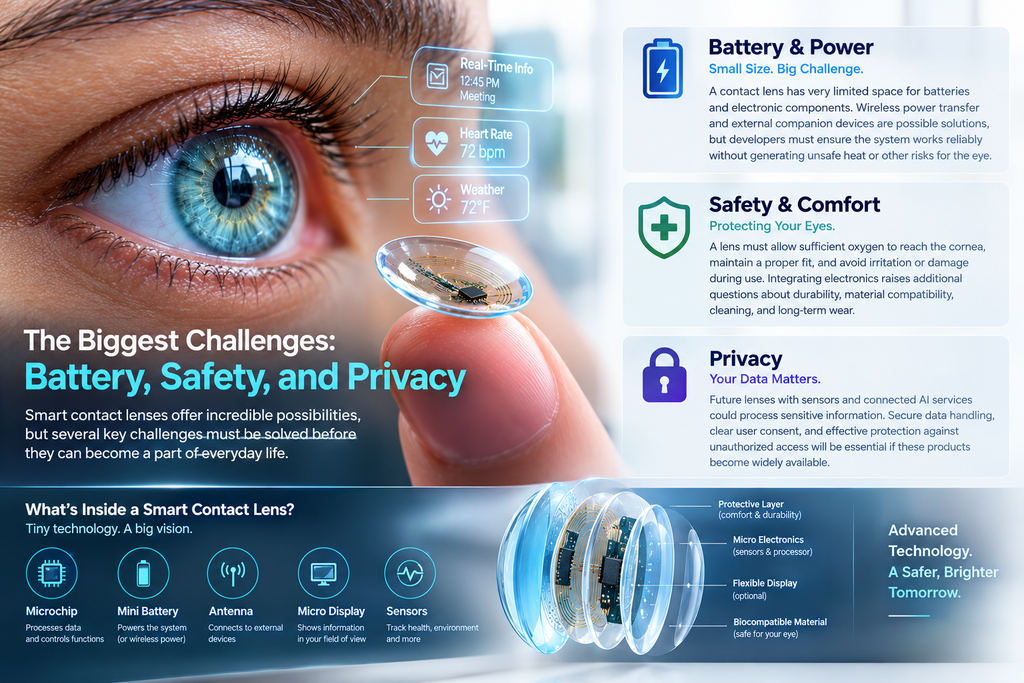
Despite their potential, smart contact lenses face substantial engineering challenges. Power is one of the most difficult problems because a contact lens has very limited space for batteries and electronic components. Wireless power transfer and external companion devices are possible approaches, but developers must ensure that the system operates reliably without generating unsafe levels of heat or creating other risks for the eye.
Safety and comfort are equally important. A lens must allow sufficient oxygen to reach the cornea, maintain an appropriate fit, and avoid irritation or damage during use. Integrating electronics introduces additional questions about durability, material compatibility, cleaning, and long-term wear. Developers must also consider privacy because future lenses equipped with sensors and connected AI services could process sensitive information. Secure data handling, clear user consent, and effective protection against unauthorized access will be essential if these products become widely available.
Will AI Smart Contact Lenses Be Available in the USA and UK in 2027?
Consumers in the United States and United Kingdom may be interested in smart contact lenses as wearable technology becomes more sophisticated. However, interest in a technology does not mean a finished product will be available to purchase. As of October 2026, there is no basis to assume that fully integrated AI contact lenses with advanced visual displays will be widely available to ordinary consumers in either market during 2027.
Before a product reaches consumers, manufacturers must demonstrate that it works consistently and meets the relevant safety and regulatory requirements. Medical versions may follow different development and approval pathways from devices intended primarily for entertainment or augmented reality. It is therefore possible that 2027 will bring demonstrations, prototypes, or specialised applications rather than a general consumer launch. Readers should watch for verified announcements about product availability, pricing, compatibility, and regulatory status rather than relying on speculative release dates.
What Could Smart Contact Lenses Cost?
The price of future AI smart contact lenses remains uncertain because fully integrated consumer products have not established a reliable retail market. Early versions could be expensive due to specialised manufacturing, miniature electronics, research costs, and limited production volumes. If the technology eventually matures, manufacturing improvements may make some models more accessible.
Pricing will also depend on the intended purpose. A lens designed for medical monitoring may have a different cost structure from a display-focused device connected to a smartphone. Consumers may also need compatible hardware, software subscriptions, or professional fitting services, depending on the final product. Until manufacturers announce genuine commercial products and prices, any specific retail estimate should be treated as speculation rather than confirmed information.
The Future of Computing Beyond 2027
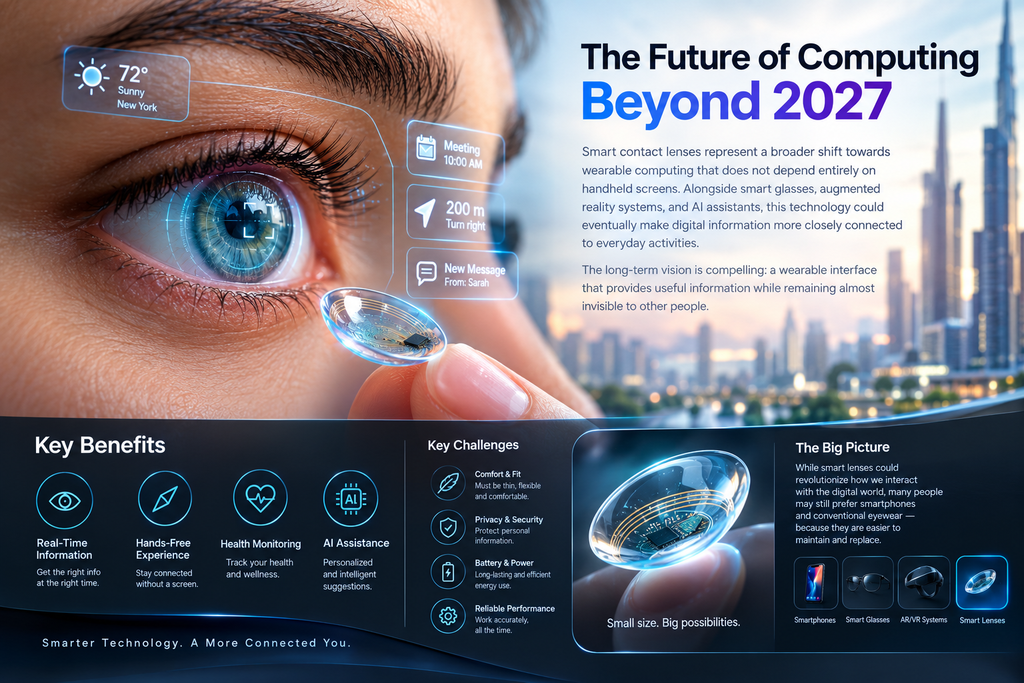
Smart contact lenses represent a broader shift towards wearable computing that does not depend entirely on handheld screens. Alongside smart glasses, augmented reality systems, and AI assistants, this technology could eventually make digital information more closely connected to everyday activities. The long-term vision is compelling: a wearable interface that provides useful information while remaining almost invisible to other people.
However, successful adoption will depend on more than impressive demonstrations. Smart lenses must offer clear advantages over existing devices, remain comfortable during appropriate use, protect personal information, and provide reliable functionality. Even after the technology advances, some people may prefer smartphones and conventional eye wear because they are easier to maintain and replace.
Final Verdict
AI smart contact lenses could become one of the most fascinating developments in wearable technology, particularly if researchers succeed in combining miniature displays, health sensors, wireless power, and AI-assisted computing. Developments planned for 2027 may offer a clearer picture of how these technologies could work together, but a widespread consumer launch should not be taken for granted.
For now, the most realistic expectation is continued experimentation, prototype demonstrations, and progress towards specialised applications. If developers can overcome the remaining challenges of safety, power, image quality, and manufacturing, smart contact lenses may eventually introduce a new way to interact with digital information. The idea of turning the eye into a personal computing interface is no longer purely science fiction, but the journey from laboratory prototype to everyday technology is still underway.
Hashtags
#AISmartContactLenses #SmartContactLenses #WearableTech #ArtificialIntelligence #AI2027 #FutureTechnology #TechTrends2027 #SmartWearables #AugmentedReality #ARTechnology #FutureOfTech #Innovation #EmergingTechnology #TechNews #NextGenTechnology #DigitalInnovation #AIWearables #FutureGadgets #TechLogic #Technology2027
Keywords
AI smart contact lenses, smart contact lenses 2027, AI wearable technology, future of wearable tech, artificial intelligence wearables, smart contact lens technology, augmented reality contact lenses, AI-powered contact lenses, next-generation wearable devices, future technology 2027, wearable technology trends, smart lenses with AI, AR smart contact lenses, emerging AI technology, advanced wearable gadgets, hands-free smart technology, future of augmented reality, innovative wearable devices, AI technology trends 2027, TechLogic.