Introduction: Why Solid-State Batteries Matter in 2027
Electric vehicles (Vs) are becoming increasingly popular, but drivers still have concerns about charging times, driving range, battery lifespan, and replacement costs. In 2027, solid-state batteries are expected to remain an important area of research as manufacturers explore new ways to improve electric vehicle performance.
Unlike conventional lithium-ion batteries, which generally use a liquid electrolyte, solid-state batteries use a solid electrolyte to transport ions between the battery’s electrodes. This alternative design could offer advantages such as higher energy density, potentially faster charging, and improved safety under certain conditions.
However, these benefits depend on the battery’s materials, design, and manufacturing process. Although solid-state technology has significant potential, consumers should distinguish between laboratory breakthroughs, limited production, and vehicles that are commercially available.
What Are Solid-State Batteries and How Do They Work?

Solid-state batteries are rechargeable batteries that use a solid electrolyte instead of the liquid electrolyte generally found in conventional lithium-ion batteries. The electrolyte allows charged ions to move between the electrodes during charging and discharging, enabling the battery to store and release energy.
Researchers are exploring different solid electrolyte materials, including ceramics, sulfide-based compounds, and polymers. Each material offers different advantages and challenges related to conductivity, durability, manufacturing, and cost.
One promising approach combines solid electrolytes with lithium-metal anodes. This design could potentially store more energy in a smaller and lighter battery. Nevertheless, manufacturers must overcome challenges involving material stability, manufacturing consistency, and long-term performance before the technology can achieve widespread commercial adoption.
Solid-State Batteries vs Traditional Lithium-Ion Batteries
Traditional lithium-ion batteries already power millions of electric cars and electronic devices. They benefit from established manufacturing processes, developed supply chains, and years of commercial experience. Solid-state batteries are being developed to improve certain aspects of existing battery technology.
| 𝐅𝐞𝐚𝐭𝐮𝐫𝐞 | 𝐋𝐢𝐭𝐡𝐢𝐮𝐦-𝐈𝐨𝐧 𝐁𝐚𝐭𝐭𝐞𝐫𝐢𝐞𝐬 | 𝐒𝐨𝐥𝐢𝐝-𝐒𝐭𝐚𝐭𝐞 𝐁𝐚𝐭𝐭𝐞𝐫𝐢𝐞𝐬 |
| Electrolyte | Generally liquid | Solid |
| Availability | Widely available | Developing technology |
| Energy density | Established performance | Potentially higher |
| Charging speed | Depends on battery design | Potentially faster |
| Safety | Requires thermal management | May reduce certain risks |
| Manufacturing cost | Established at scale | Challenging to scale |
| Lifespan | Varies by chemistry and use | Depends on design and testing |
Solid-state batteries could offer meaningful improvements, but they will not automatically outperform every conventional battery. Performance depends on battery chemistry, operating temperature, charging conditions, and manufacturing quality.
Could Solid-State Batteries Make Electric Cars Charge Faster?

Charging speed is one of the most attractive potential benefits of solid-state batteries. Electric vehicle drivers want shorter charging stops, particularly when travelling long distances or relying on public charging stations. Batteries capable of supporting faster charging could make electric cars more convenient for commuters and families.
However, charging speed depends on more than the battery itself. The vehicle’s charging system, thermal management, charging station capacity, and battery chemistry all influence charging time.
Manufacturers have announced ambitious targets for future battery technology, but development targets should not be confused with proven commercial performance. In 2027, buyers in the UK and USA should look for independently verified charging results rather than relying exclusively on promotional claims.
Could Solid-State Batteries Increase Electric Car Range?
Driving range is another major reason manufacturers are investing in next-generation batteries. Higher energy density could allow electric vehicles to travel farther without requiring significantly larger or heavier battery packs.
For drivers, improved range could mean fewer charging stops during road trips and greater flexibility when travelling between cities. It could also help manufacturers develop lighter vehicles or reduce battery size while maintaining useful driving distances.
Nevertheless, real-world range depends on several factors, including weather, driving speed, heating, air conditioning, tyree selection, and vehicle weight. Solid-state batteries may improve future possibilities, but their actual benefits must be measured in production vehicles under realistic driving conditions.
Will Solid-State Batteries Become Cheaper in 2027?
Cost remains one of the biggest obstacles to solid-state battery adoption. Developing new materials, building specialised factories, and maintaining consistent manufacturing quality require substantial investment. Early production may therefore be more expensive than established lithium-ion battery manufacturing.
Over time, higher production volumes, improved manufacturing techniques, and more efficient material use could help reduce costs. However, lower prices are not guaranteed because raw materials, factory construction, and production complexity will continue to influence manufacturing expenses.
For consumers in the UK and USA, the key question is whether solid-state technology will eventually make electric cars more affordable. In 2027, buyers should compare the purchase price, battery warranty, charging performance, and total ownership costs of vehicles currently available.
The Biggest Challenges Preventing Mass Production

Despite their promise, solid-state batteries face important technical challenges. Some solid electrolytes are difficult to manufacture consistently, while contact between battery materials can deteriorate during repeated charging cycles. Certain designs also face problems involving dendrite formation, mechanical stress, and performance at different temperatures.
Manufacturers must solve these issues while producing batteries that remain reliable over thousands of charging cycles. They also need production facilities capable of manufacturing large quantities at competitive prices.
Independent testing is equally important. A successful laboratory demonstration does not necessarily prove that a battery will perform reliably in an electric vehicle for many years. Long-term durability, safety certification, and consistent manufacturing quality will be essential for widespread adoption.
What UK and USA Drivers Should Expect in 2027
Electric vehicle buyers in the United Kingdom and the United States should expect continued innovation in battery technology. However, the speed of solid-state adoption will depend on individual manufacturers, production capacity, vehicle development schedules, and commercial costs.
Some companies may introduce limited applications or early production models, while others may continue testing their technology. It would be premature to assume that solid-state batteries will replace conventional lithium-ion batteries across the entire automotive industry in 2027.
Anyone planning to buy an electric car should focus on currently available driving range, charging-network access, battery warranties, vehicle prices, and maintenance costs. Following verified manufacturer announcements can help buyers understand future developments without relying on unconfirmed promises.
The Future of Solid-State Batteries Beyond 2027
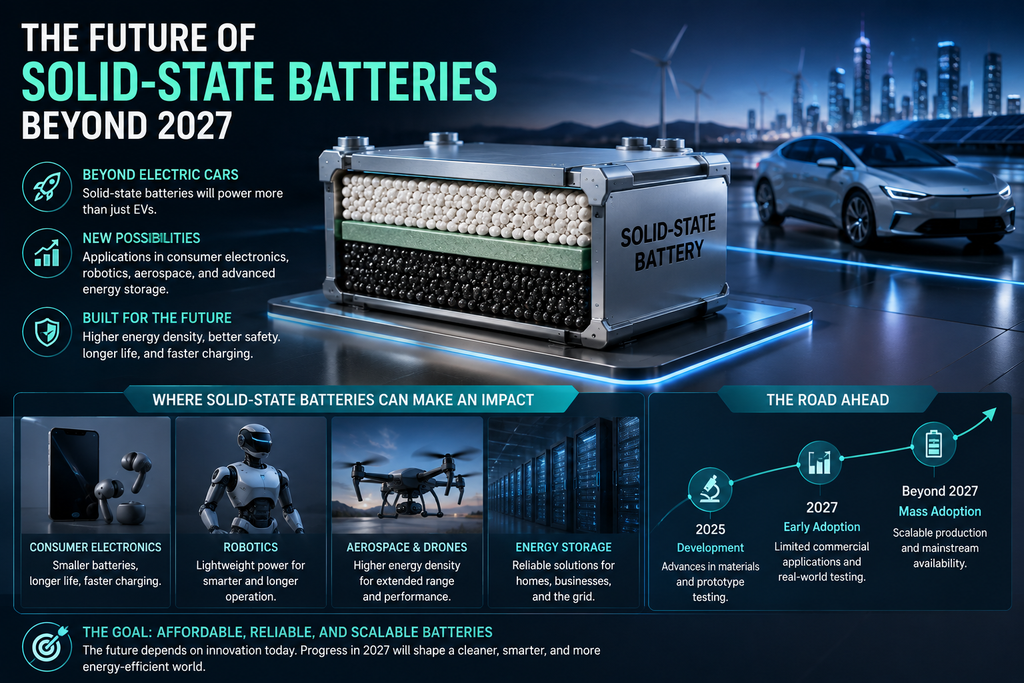
Solid-state batteries could eventually influence industries beyond electric vehicles. If manufacturers develop reliable, affordable, and salable designs, the technology may find applications in consumer electronics, robotics, and selected energy-storage systems.
Competition from improved lithium-ion batteries, lithium-iron-phosphate batteries, and other emerging technologies will also shape the market. Solid-state batteries will need to demonstrate clear advantages in cost, performance, reliability, or size to justify widespread adoption.
The most important milestone will be the ability to manufacture dependable batteries at scale and integrate them into products that consumers can afford. Progress during 2027 could help determine how quickly this promising technology moves from development into everyday use.
Conclusion
Solid-state batteries represent a promising direction for electric vehicle technology in 2027. Potential benefits include higher energy density, faster charging under suitable conditions, and improved safety characteristics. However, manufacturing costs, durability, material challenges, and large-scale production remain significant obstacles.
For drivers in the UK and USA, the best approach is to follow verified developments while evaluating electric vehicles based on their current performance and ownership costs. If manufacturers overcome the remaining challenges, solid-state batteries could become an important part of the next generation of electric cars.
Hashtags
#SolidStateBatteries #SolidStateBattery2027 #BatteryTechnology #ElectricVehicles #EVTechnology #FutureOfEVs #BatteryInnovation #EVBatteries #FutureTechnology #CleanEnergy #ElectricCars2027 #LithiumIonBatteries #AutomotiveTechnology #TechTrends2027 #TechLogic
Keywords
Solid-state batteries in 2027, solid-state battery technology, solid-state batteries for electric cars, electric vehicle battery technology, future of solid-state batteries, solid-state vs lithium-ion batteries, solid-state battery charging speed, solid-state battery range, solid-state battery advantages, solid-state battery disadvantages, EVE battery innovations 2027, next-generation battery technology, solid-state battery cost, solid-state battery lifespan, future electric cars, advanced EVE batteries, solid electrolyte batteries, lithium-metal batteries, electric vehicle technology 2027, solid-state battery mass production, EVE technology trends, battery technology USA, battery technology UK, future of electric vehicles, TechLogic