OpenAI has already changed the way people interact with technology through ChatGPT and other artificial intelligence products. Now, the company appears to be moving toward something much bigger: dedicated AI hardware.
Reports and industry discussions have suggested that OpenAI is working on a new AI-focused device that could arrive around 2027. The project has attracted attention because it could introduce a completely different way of interacting with artificial intelligence—one that does not depend entirely on a traditional smartphone, laptop, or desktop computer.
While OpenAI has not officially revealed a complete consumer product or confirmed every detail, the possibility of an OpenAI AI device has created major interest. Here is what we know so far and what the future device could potentially offer.
What Is the OpenAI AI Device?
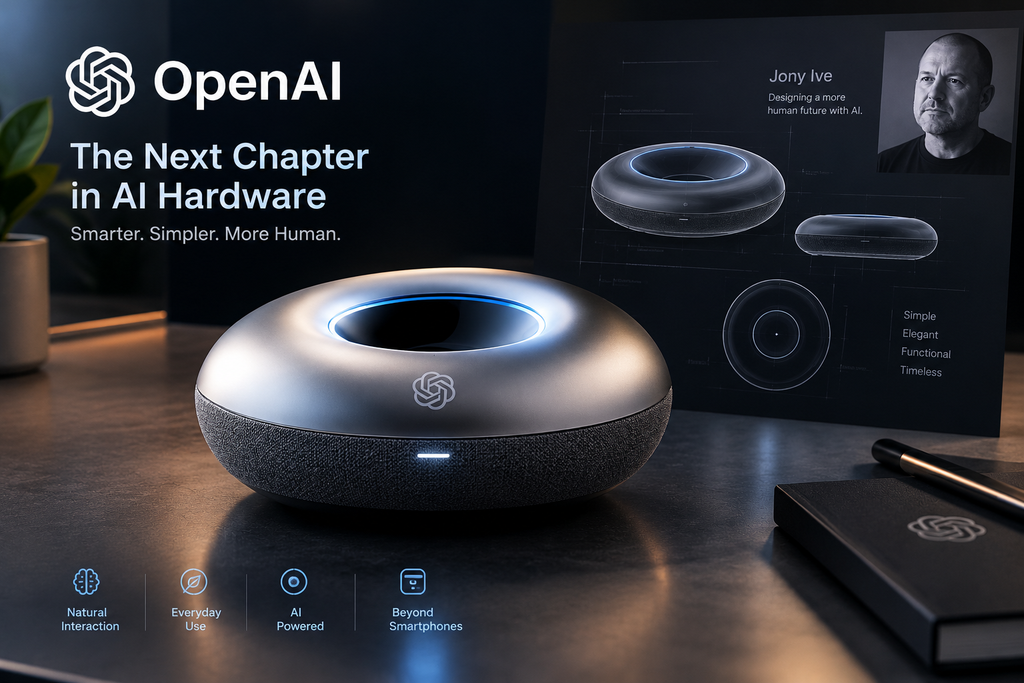
The OpenAI AI device is expected to be a dedicated hardware product designed primarily around artificial intelligence.
Instead of building another conventional smartphone with an AI assistant added to it, OpenAI could take a different approach. The device may be designed from the beginning to make AI the central part of the user experience.
This could mean users would interact with an AI assistant through voice, gestures, a compact display, or other forms of natural interaction rather than relying on traditional apps and menus.
The exact design and product category remain unclear. It could be a small standalone device, a wearable, or an entirely new type of consumer hardware.
Why Is OpenAI Building Hardware?
One major reason could be control over the complete AI experience.
Today, ChatGPT is primarily accessed through smartphones, computers, web browsers, and third-party devices. These platforms give users access to powerful AI, but the experience is still controlled by operating systems and hardware designed by other companies.
Dedicated hardware could allow OpenAI to create a device specifically optimized for AI.
This could give the company greater control over the microphone, speakers, sensors, processing, connectivity, software interface, and interaction model.
Rather than asking users to open an app and type a question, an AI-first device could make the assistant available almost instantly.
Possible Design of the OpenAI Device
The final design is one of the biggest unanswered questions.
OpenAI has not publicly confirmed the final appearance, dimensions, or materials of the device. However, an AI-first product would likely prioritize simplicity and portability.
A compact design could make it easy to carry throughout the day. Instead of looking like a traditional smartphone, the device could potentially have a minimal interface with fewer physical controls.
The hardware might include microphones, speakers, cameras, sensors, and possibly a small display. However, these features should be considered possibilities rather than confirmed specifications.
The main goal would likely be to make interaction with AI feel natural and immediate.
AI Could Be the Main Interface
The biggest difference between an OpenAI device and conventional electronics could be the user interface.
Smartphones are built around applications. Users normally open an app, find a feature, press buttons, and complete a task.
An AI-first device could reduce many of these steps.
For example, a user might simply say what they want to accomplish. The AI could understand the request, find the relevant information, perform supported actions, and provide a response.
Instead of thinking about which application to use, users could simply communicate their goal.
This could make AI feel less like an application and more like a personal digital assistant.
Voice Interaction Could Be Important
Voice could become one of the most important ways to use an OpenAI AI device.
Modern AI models are becoming increasingly capable of understanding natural conversations. A dedicated device could take advantage of this by keeping microphones ready for fast interactions.
Users could potentially ask questions, summarize information, translate languages, create reminders, search for information, or control supported services through conversational commands.
The objective would not necessarily be to make users talk to a machine constantly. Instead, the device could provide a faster and more natural way to interact when using a screen is inconvenient.
Could It Have a Display?
Another major question is whether the OpenAI device will include a conventional screen.
A display could be useful for showing messages, navigation information, notifications, visual answers, or controls. However, OpenAI could also choose to minimize screen dependence.
A smaller display combined with voice and AI could be enough for many everyday tasks.
This would make the device different from a smartphone, where the large touchscreen is the primary interface.
At this stage, however, there is no confirmed final display specification.
Could It Replace a Smartphone?
This is perhaps the biggest question surrounding OpenAI’s hardware project.
A smartphone remains extremely versatile. It provides a large display, cameras, cellular connectivity, applications, payments, navigation, messaging, gaming, photography, and entertainment.
For an AI device to completely replace a smartphone, it would need to provide alternatives to many of these functions.
A more realistic possibility is that an OpenAI device would initially work alongside smartphones rather than replace them.
It could handle AI-related tasks while the smartphone remains the main device for traditional computing.
Personal AI Could Be the Biggest Feature
One of the most interesting possibilities is a highly personalized AI assistant.
Instead of simply answering questions, the device could potentially understand a user’s preferences, routines, and commonly performed tasks—while giving users meaningful control over their personal data.
For example, an AI assistant could help organize information, summarize conversations, prepare messages, manage schedules, or provide context based on previous interactions.
The long-term vision could be an AI companion that understands what the user is trying to accomplish rather than simply responding to individual commands.
Privacy and Security Will Be Critical
An AI device that constantly listens, processes personal information, or interacts with other services would create important privacy questions.
Users would need clear controls over microphones, cameras, location information, personal data, and AI memory.
Security would also be extremely important because a device capable of taking actions on behalf of its owner could potentially have access to sensitive accounts and information.
For an AI hardware product to gain widespread adoption, users would need to trust not only the AI itself but also the company operating the system.
OpenAI Device and the Future of AI Hardware
If OpenAI successfully creates a useful AI-first device, it could influence the wider technology industry.
Companies such as Apple, Google, Samsung, Meta, and other major technology manufacturers are already investing heavily in artificial intelligence and new hardware experiences.
The next generation of devices may therefore move away from simply adding AI features to existing products.
Instead, AI could become the foundation of the entire device.
That could eventually lead to new categories of personal technology that are difficult to describe using today’s familiar terms such as smartphone, tablet, or computer.
When Could the OpenAI AI Device Launch?
The exact launch date remains uncertain.
Reports and industry discussions have pointed toward a possible 2027 time frame, but OpenAI has not provided a complete official launch schedule for a consumer AI device.
This means 2027 should be viewed as a potential time frame rather than a guaranteed release date.
The project could also change significantly before reaching consumers. Hardware development involves engineering, manufacturing, software integration, testing, regulatory requirements, and supply-chain decisions.
What Could Make the Device Successful?
The success of an OpenAI device would depend on more than having a powerful AI model.
It would need to solve real problems better than smartphones and existing AI applications.
The device would need fast responses, reliable connectivity, strong battery life, excellent microphones and speakers, intuitive interaction, useful software integration, and strong privacy protections.
Most importantly, users would need a clear reason to carry another device.
If the product simply duplicates features already available on a smartphone, convincing consumers to buy it could be difficult.
However, if it provides a genuinely faster and more natural way to use AI, it could create an entirely new category.
Final Thoughts
The rumored OpenAI AI device could become one of the most interesting developments in consumer technology if it reaches the market around 2027.
The idea is especially exciting because OpenAI would not simply be adding artificial intelligence to an existing hardware category. The company could potentially design a device around AI from the ground up.
However, many important details—including the final design, specifications, price, operating system, exact launch date, and whether it will include a screen—remain unknown.
For now, the OpenAI AI device should be viewed as an emerging project rather than a fully confirmed consumer product.
If OpenAI can create hardware that makes AI genuinely easier, faster, and more natural to use, 2027 could mark an important new chapter in the evolution of personal technology.
Hashtags
#OpenAI #OpenAI2027 #OpenAIHardware #AIDevice #AIHardware #ArtificialIntelligence #OpenAIDevice #AI2027 #FutureOfAI #FutureTechnology #AIInnovation #TechNews #TechnologyNews #AITrends #SmartDevices #AIAssistant #ChatGPT #OpenAIChatGPT #TechTrends #FutureTech #AITechnology #Tech logic
Keywords
OpenAI AI Device 2027, OpenAI AI device, OpenAI hardware, OpenAI 2027 device, OpenAI hardware 2027, OpenAI AI gadget, OpenAI device launch, OpenAI new device, OpenAI AI hardware, AI device 2027, future AI devices, artificial intelligence hardware, OpenAI technology, OpenAI latest device, AI-powered device, AI assistant device, next-generation AI device, future of AI, AI technology 2027, OpenAI innovation, ChatGPT hardware, OpenAI wearable device, AI-first device, smart AI device, future technology, AI gadget, AI hardware trends, Tech logic