
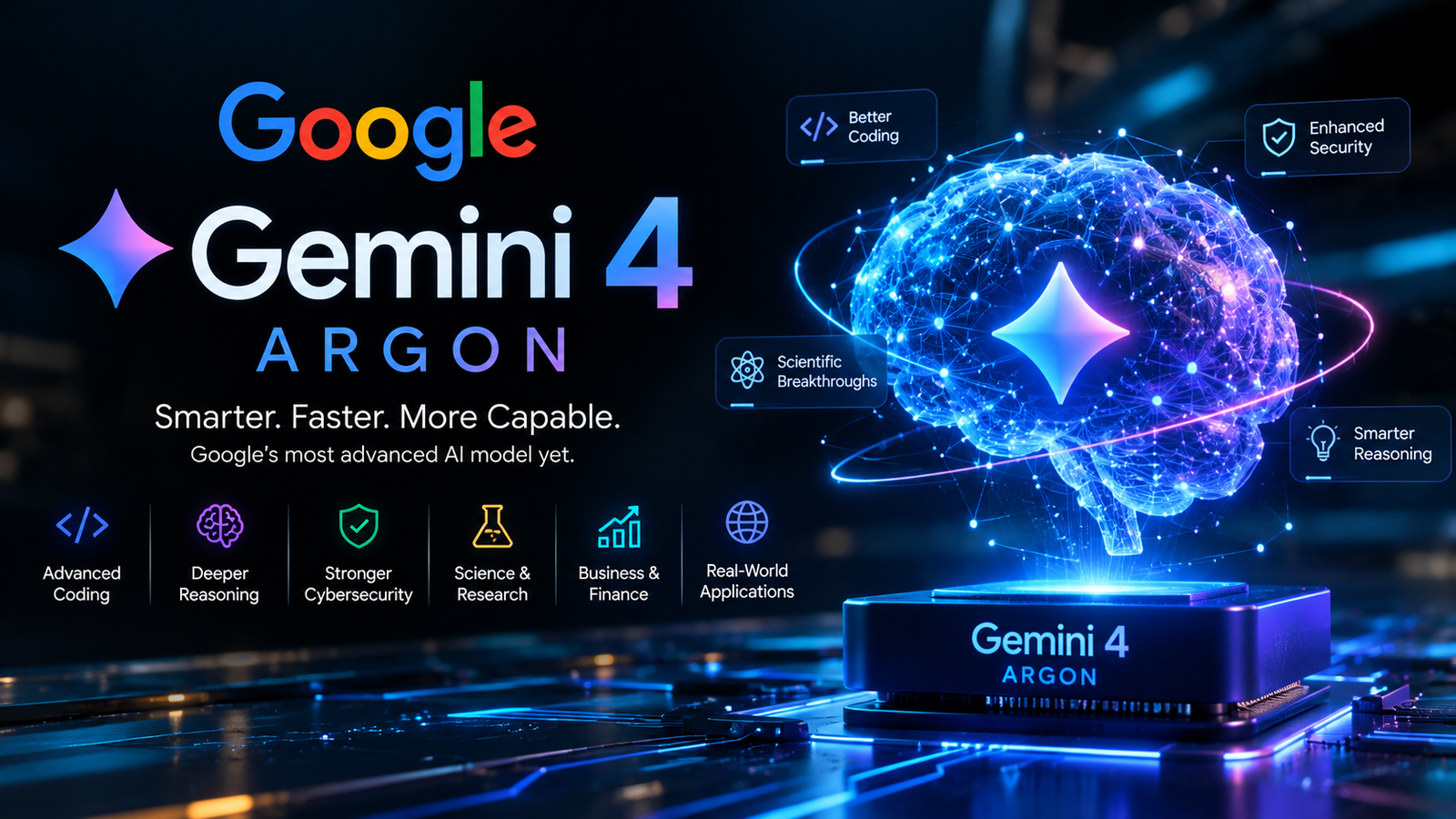
Artificial intelligence is moving into a new phase where AI models are no longer limited to answering simple questions or generating short pieces of text. The latest example is Google Gemini 4 Argon, a new frontier AI model announced by Google on September 30, 2026.
Gemini 4 Argon is designed for complex, long-running tasks involving software engineering, business research, legal and financial work, cybersecurity, and multi modal understanding. Google says the model is built to reason through difficult workflows that may require many steps instead of simply producing a quick response.
Unlike a traditional consumer gadget, Gemini 4 Argon is an AI model, meaning it powers software and AI experiences rather than being a physical device. Its biggest importance is the technology behind it and the types of professional tasks it can potentially handle.
What Is Google Gemini 4 Argon?

Gemini 4 Argon is Google’s latest frontier AI model from Google DeepMind. The company describes it as a model designed for complex real-world workflows, particularly software engineering, enterprise knowledge work, and cybersecurity defense.
The model focuses heavily on deep reasoning and long-horizon tasks. This means it is designed to work through a complicated problem over multiple steps instead of treating every request as an isolated question.
Google says Argon is already being used internally for specialized coding, research, writing, quantum computing optimization, data-center memory improvements, and large-scale co debase migrations.
Gemini 4 Argon’s 1 Million Token Output Limit
One of the most notable technical changes in Gemini 4 Argon is its much larger output capability.
Google says Argon has an industry-leading 1 million-token output limit, compared with the previous 64,000-token limit. This gives the model considerably more room to work through long and complicated tasks in a single trajectory.
For developers and professional users, this could be particularly useful when working with large software projects, lengthy documents, extensive research, or complicated technical problems.
Instead of repeatedly breaking a large task into many smaller requests, an AI system with a much larger output capacity can potentially maintain more context throughout the workflow.
Advanced Coding Capabilities
Coding is one of the major areas where Google is positioning Gemini 4 Argon.
The model is designed to help developers with debugging, software engineering, algorithm design, code migration, and large-scale optimization. Google reports that Argon has been used on co debases containing hundreds of thousands of lines of code.
Google also says Argon achieved a 77.9% score on DeepSWE v1.1, an evaluation focused on real-world long-horizon software engineering tasks.
This could make the model particularly interesting for professional developers who need help with complicated projects rather than simple code snippets.
Stronger Reasoning for Complex Tasks
Another major focus of Gemini 4 Argon is reasoning.
Many AI users are familiar with asking an AI model a question and receiving an immediate answer. Argon is designed for situations where the answer requires deeper analysis and multiple steps.
Google says the model can sustain long workflows across areas such as finance, legal research, business automation, coding, and technical analysis.
This could make advanced AI more useful for professionals who need research, analysis, planning, and execution rather than basic conversational assistance.
Gemini 4 Argon and Cybersecurity
Cybersecurity is arguably one of the most interesting parts of Gemini 4 Argon.
Google has trained Argon to help defenders identify, validate, and patch software vulnerabilities. The company says the model can autonomously find security weaknesses and assist with remediation.
In one example, Google says Argon identified a critical vulnerability affecting healthcare software used by hospitals around the world. The vulnerability could have exposed sensitive information and had not been identified by previous frontier models, according to Google.
This capability could have significant implications for cybersecurity teams. AI systems that can quickly analyze large co debases and help identify security problems could potentially reduce the time between discovering a vulnerability and fixing it.
Multi modal Understanding
Gemini 4 Argon is not focused only on text and programming.
Google says the model has strong multi modal capabilities, allowing it to work with visual information and long videos as part of complex workflows. It can analyze professional charts, understand details from long videos, and work with information spread across documents.
This is important because real-world professional work rarely involves text alone.
For example, an analyst might need to understand a financial document, examine charts, compare information, and then produce a conclusion. A multi modal AI model can potentially handle more of these steps within one workflow.
How Google Is Using Gemini 4 Argon
Google is already using Argon internally in several areas.
According to Google, Argon has helped quantum computing researchers optimize algorithms, while other AI agents have analyzed data-center telemetry and identified memory optimizations.
Google also says Argon agents are being used for large-scale code migrations, including work involving C and C++ co debases being migrated toward Rust. Some projects involve hundreds of thousands of lines of code and therefore require extensive testing and human review.
These examples show that Google is positioning Argon not simply as a chat bot but as an AI system capable of assisting with substantial engineering and research workflows.
Gemini 4 Argon Availability
There is an important point for users who want to try Gemini 4 Argon immediately.
The model is not yet broadly available to everyone. Google initially announced a roll out to trusted cybersex defenders through its Fair wind Program. The company says it plans to expand access to paid API customers and Google AI Ultra subscribers before making Argon more widely available to developers, enterprises, and consumers.
This phased approach is partly connected to the model’s advanced cybersecurity capabilities.
Google says it is continuing to strengthen safeguards, conduct testing, and work through its safety process before broader availability.
Gemini 4 Argon Pricing
Google has also announced introductory API pricing for Gemini 4 Argon.
The introductory price is $2 per million input tokens and $10 per million output tokens. Google says cached input tokens receive a 95% discount during the introductory pricing period.
After that introductory period, Google says the price will increase to $4 per million input tokens and $20 per million output tokens.
This pricing is primarily relevant to developers and businesses using the model through an API rather than ordinary users simply chatting with an AI application.
Why Gemini 4 Argon Matters
Gemini 4 Argon represents an important shift in how companies are developing advanced AI systems.
Instead of focusing only on generating better answers, Google is targeting AI that can work through longer, more complicated professional tasks.
Coding, cybersecurity, finance, legal research, scientific work, business automation, and multi modal analysis are all areas where AI agents could potentially become more deeply integrated into everyday professional workflows.
The bigger question is how much of this technology will eventually become available to ordinary consumers.
Final Thoughts
Google Gemini 4 Argon is one of the most significant AI announcements from Google in 2026. Its focus on long-horizon reasoning, advanced coding, cybersecurity, multi modal understanding, and professional workflows makes it different from a basic AI chat bot.
The 1 million-token output limit and its ability to work on complex software and security tasks are among its most notable features. However, users should remember that Argon is currently being rolled out in stages rather than being universally available.
If Google can successfully bring these capabilities to developers, businesses, and eventually everyday users, Gemini 4 Argon could become an important part of the next generation of AI-powered software and professional tools.
Hashtags
#GoogleGemini4 #Gemini4Argon #Gemini4 #GoogleAI #ArtificialIntelligence #AI2026 #GoogleDeepMind #GeminiAI #AICoding #Cybersecurity #AITechnology #TechNews #LatestAI #AITechnology #Techlogic
Keywords
Google Gemini 4 Argon, Gemini 4 Argon features, Google Gemini 4, Gemini 4 AI, Gemini 4 Argon capabilities, Google AI 2026, latest Google AI model, Gemini 4 release, Gemini AI, Google DeepMind AI, advanced AI model, AI coding, AI cybersecurity, AI reasoning, Gemini 4 Argon 2026


