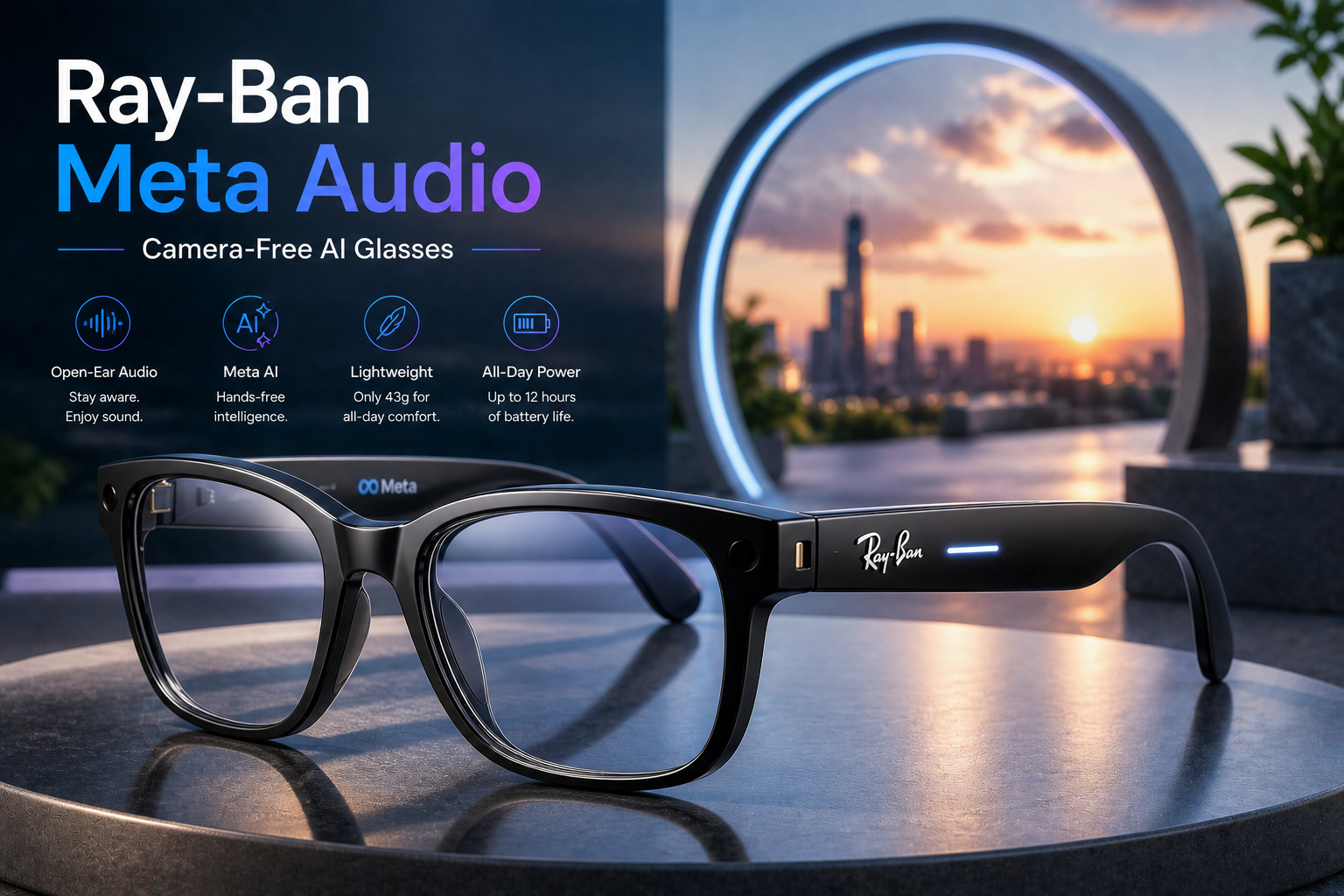
Ray-Ban Meta Audio Glasses – Camera-Free AI Smart Glasses 2026: The Future of Camera-Free AI Glasses
Smart glasses are a growing category in consumer technology, like Ray-Ban Meta Audio Glasses – Camera-Free AI Smart Glasses 2026.
Meta pushes the idea forward with Ray-Ban Meta Audio Glasses – Camera-Free AI Smart Glasses 2026.
Unlike traditional camera-equipped smart glasses, Ray-Ban Meta Audio removes the camera completely. Instead, the glasses focus on open-ear audio, calls, music, Meta AI and hands-free interaction.
Meta officially introduced Ray-Ban Meta Audio at Meta Connect 2026 as its first dedicated audio glasses. The new design gives users a more traditional-looking pair of glasses while adding smart features without requiring a camera.
What Are Ray-Ban Meta Audio Glasses?
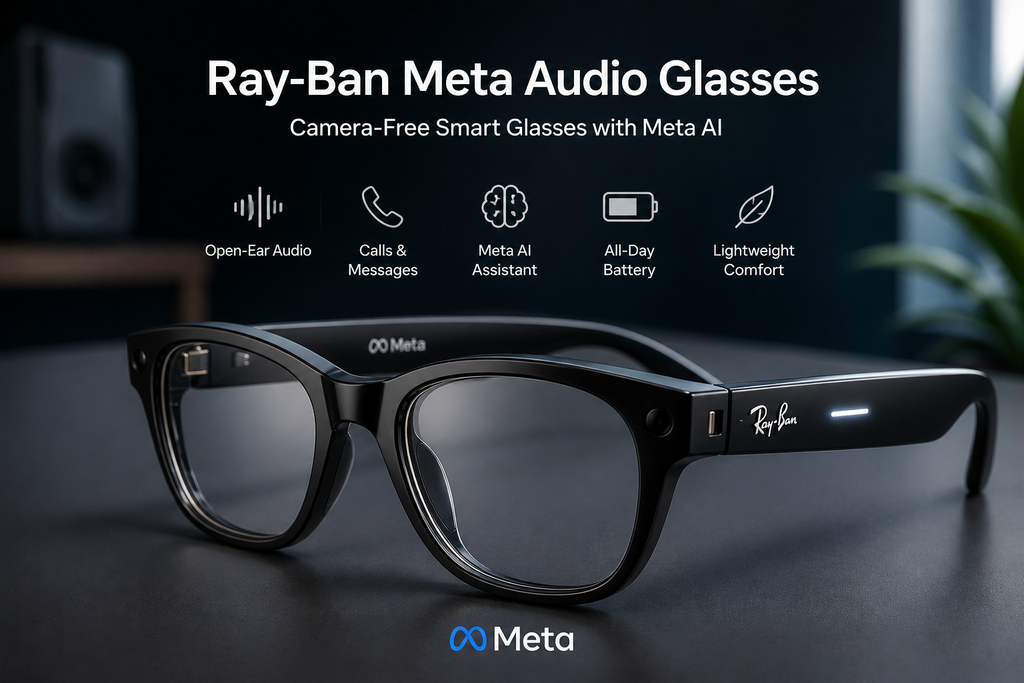
Ray-Ban Meta Audio is a new generation of smart glasses created through the partnership between Meta and EssilorLuxottica, the company behind Ray-Ban.
The biggest difference is simple: there is no camera.
These glasses do not capture photos or videos. They are designed primarily for listening, communication, and AI interaction.
Users can listen to music and podcasts, make calls, and interact with Meta AI, using other audio-based features without taking their smartphone out of their pocket.
This makes the product different from Mete’s camera-equipped Ray-Ban smart glasses. Rather than trying to put every smart feature into one pair of glasses, Meta is also exploring more specialized designs.
For people who want smart functionality but are uncomfortable with camera-equipped eye wear, this approach could be particularly interesting.
Why Did Meta Remove the Camera?
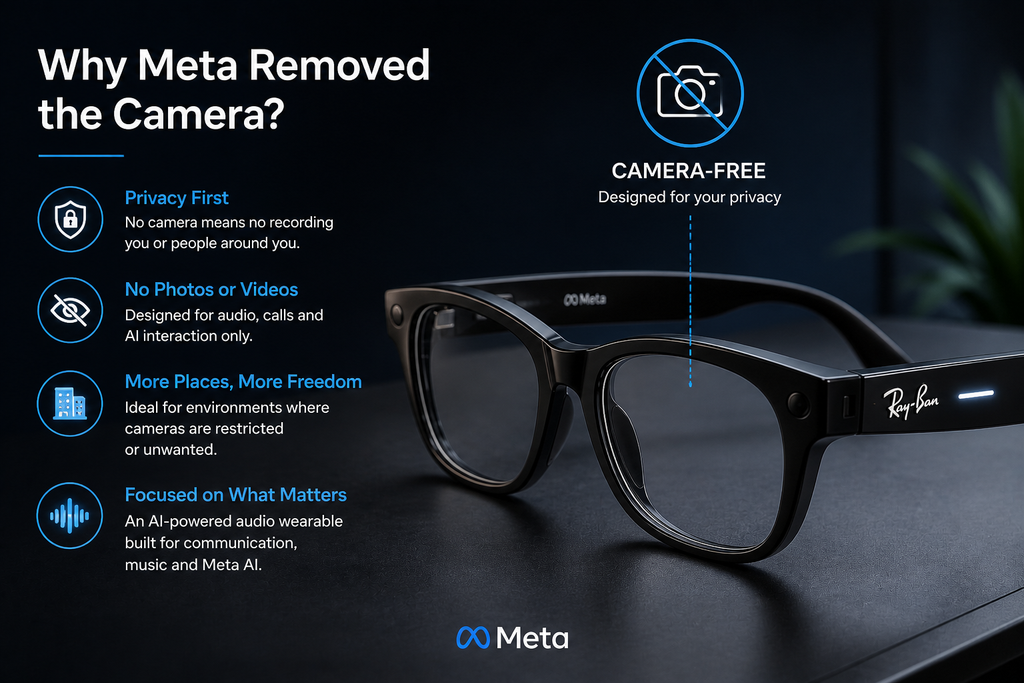
The removal of the camera is probably the most important feature of Ray-Ban Meta Audio.
Camera-enabled glasses raise privacy concerns, as nearby people may not know when they are recorded. Mete’s new audio-only design, Ray-Ban Meta Audio Glasses – Camera-Free AI Smart Glasses 2026, removes that specific capability.
Because there is no camera, the glasses cannot be used to capture photos or videos. That creates a much simpler privacy proposition compared with camera-equipped smart glasses.
It also gives Meta a way to offer smart eye wear for environments where cameras may be restricted or unwanted.
However, removing the camera also means giving up camera-based features. Users cannot use the glasses to capture images or rely on visual AI features that require a camera.
This makes Ray-Ban Meta Audio less of an all-purpose smart camera and more of an AI-powered audio wearable.
Meta AI Is at the Center
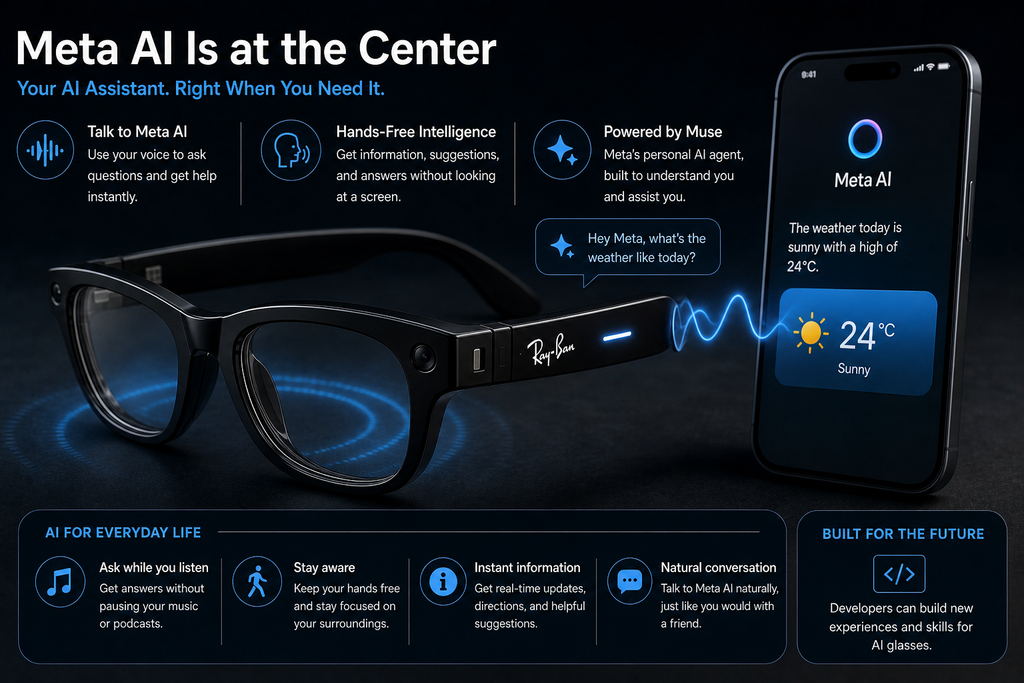
Artificial intelligence is one of the biggest reasons these glasses are interesting.
Meta is expanding its AI assistant across its hardware ecosystem, including its smart glasses. The company introduced Muse as a personal AI agent and is integrating the technology into its wearable strategy.
With Ray-Ban Meta Audio, users can interact with Meta AI using their voice. This creates a hands-free experience where users can ask questions, get information and interact with AI without constantly looking at a screen.For everyday situations, that could be useful.
Imagine walking outside while listening to music and asking an AI assistant a question without reaching for your phone. Or imagine getting information while keeping your hands free.
Meta is clearly moving toward an environment where AI becomes something people can access naturally throughout the day rather than something they only open inside a smartphone application. Meta is also providing developers with new ways to build experiences for AI glasses.
Open-Ear Audio for Everyday Use
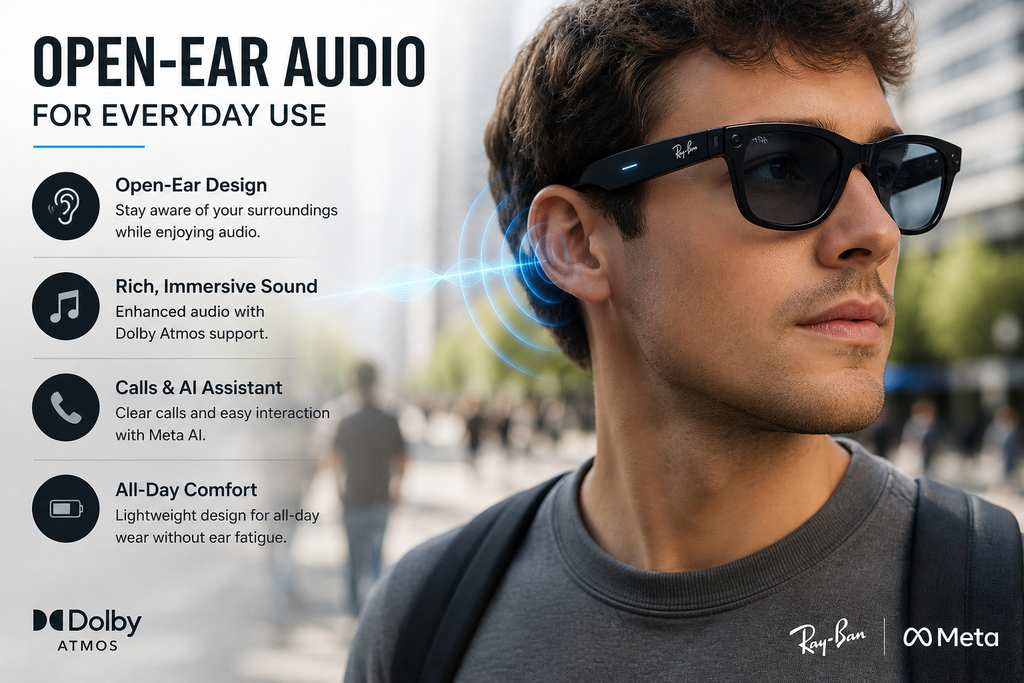
Audio is the main focus of Ray-Ban Meta Audio.
The glasses use an open-ear approach, meaning users can listen to audio while remaining aware of their surroundings. This is important for people who want music, podcasts or calls without completely blocking environmental sounds.
The glasses are designed to work more like wearable speakers built into a familiar pair of eye wear.
Meta has also highlighted improved audio capabilities, while reporting around the launch has pointed to Dolby Atoms support.
For commuters, walkers and people working throughout the day, this could make the glasses more convenient than repeatedly putting in and removing traditional earbuds.
The idea is not necessarily to replace headphones completely. Instead, Ray-Ban Meta Audio offers another way to consume audio while keeping the ears relatively open to the surrounding environment.
Lightweight Design and Battery Life

Comfort is extremely important for wearable technology.
According to launch reporting, Ray-Ban Meta Audio weighs about 43 grams, while the removal of cameras helps create a lighter and more streamlined design. Meta has also focused on ergonomic improvements for everyday use.
Battery life is another important part of the experience.
Meta is targeting up to 12 hours of use, depending on usage conditions. That is significant because smart glasses need enough battery capacity to remain useful throughout a normal day.
Longer battery life can make a wearable feel more practical. If users constantly need to recharge their glasses, they may eventually stop carrying them.
The goal of Ray-Ban Meta Audio is therefore not just to add technology to glasses but to make the glasses feel like something people could actually wear regularly.
Calls, Music and Hands-Free Interaction

Ray-Ban Meta Audio is designed to handle several everyday audio tasks.
Users can listen to music, podcasts and other audio content. They can also take calls and communicate with Meta AI through voice interaction.
This creates a more hands-free experience.
Instead of taking out a smartphone to perform every small action, users can potentially complete simple interactions through voice.
That does not mean smartphones are becoming unnecessary overnight. Phones still offer much larger displays, advanced cameras, apps, gaming, messaging interfaces and many other capabilities.
Instead, smart glasses can work as an additional interface that reduces the number of times people need to reach for their phones.
Ray-Ban Meta Audio vs Camera Smart Glasses

The biggest difference between Ray-Ban Meta Audio and camera-equipped smart glasses is their purpose.
Camera-equipped glasses can capture images and videos and support visual AI experiences. Ray-Ban Meta Audio focuses on sound and voice.
This creates a clear trade-off.
With Ray-Ban Meta Audio, users gain a more privacy-focused design because there is no camera. They also get a lighter and more audio-focused product.
However, they lose camera-based capabilities.
Meta is continuing to offer camera-equipped Ray-Ban smart glasses alongside the new Audio model. Reports from Meta Connect indicate that the camera-equipped Ray-Ban Meta Gen 3 starts at $449, while Ray-Ban Meta Audio starts at $349.
This gives consumers different options depending on which features they want.
Price and Release Date

Price is always important when a new wearable enters the market.
Meta announced Ray-Ban Meta Audio with a starting price of $349. Current launch reporting says the glasses are scheduled to ship on October 13, 2026.
That puts the product below the starting price reported for the new Ray-Ban Meta Gen 3.
The lower price and camera-free design could make Ray-Ban Meta Audio an interesting option for consumers who want AI and audio features without paying for camera hardware.
Availability, pricing and configurations can vary by market, so buyers should check official regional listings when the glasses become available.
Can Ray-Ban Meta Audio Replace a Smartphone?

Probably not.
At least based on the current feature set, these glasses are better understood as a companion device rather than a smartphone replacement.
A smartphone remains much more versatile. It has a large touchscreen, powerful applications, advanced photography, navigation, gaming, video and many other functions.
Ray-Ban Meta Audio instead focuses on quick, hands-free interactions.
The interesting possibility is that people may use their phones less often for small tasks. Asking a question, listening to audio, taking a call or interacting with an AI assistant may not require pulling a phone out of a pocket.
That could gradually change how people interact with their devices.
Privacy Could Become a Major Selling Point

Privacy is likely to remain an important issue for smart glasses.
The camera-free design gives Ray-Ban Meta Audio a straightforward advantage in one specific area: the glasses do not have a camera for recording photos or videos.
That does not mean every privacy concern disappears. The glasses still involve microphones, wireless connectivity and AI services, so users should understand how voice data and other information are processed.
Meta has also discussed privacy and private-processing measures as part of its broader AI glasses strategy.
As smart glasses become more common, transparency around data collection and processing will likely remain important.
The Future of AI Glasses

Ray-Ban Meta Audio shows that the future of smart glasses may not follow a single design.
Some glasses may include cameras. Others may focus on audio. More advanced models may add displays, AI agents and other capabilities.
Meta is expanding its AI glasses ecosystem rapidly, and the company says developers can now build experiences using tools for AI glasses.
This suggests that smart glasses could eventually become another major computing platform alongside smartphones, watches and computers.
The biggest challenge will be convincing consumers that glasses provide enough everyday value to become a normal part of their routine.
Final Thoughts
Ray-Ban Meta Audio Glasses represent an interesting shift in the smart-glasses market. Instead of adding more cameras and sensors, Meta has created a product that focuses on audio, AI and hands-free interaction.
The camera-free design may appeal to people who want smart functionality without the privacy concerns associated with recording-capable glasses.
With Meta AI, open-ear audio, calls, music, a lightweight design and a starting price of $349, Ray-Ban Meta Audio is positioned as a more focused wearable rather than a replacement for the smartphone.
Whether people eventually choose AI glasses over traditional earbuds or use both together remains to be seen. But one thing is clear: Meta is continuing to invest heavily in glasses as an important interface for the next generation of AI.
Hashtags
#RayBanMetaAudio #RayBanMeta #MetaAudio #MetaAI #AIGlasses #SmartGlasses #CameraFreeGlasses #AIWearables #WearableTechnology #ArtificialIntelligence #TechNews #NewGadgets #FutureTechnology #SmartTech #TechTrends #Technology2026 #MetaConnect #AudioGlasses #Techlogic
Keywords
Ray-Ban Meta Audio Glasses, Ray-Ban Meta Audio, Meta Audio Glasses, camera-free AI glasses, Meta AI glasses, Ray-Ban smart glasses 2026, Meta smart glasses 2026, AI glasses 2026, camera-free smart glasses, Meta AI wearable, Ray-Ban Audio price, Ray-Ban Audio release date, Ray-Ban Meta Audio features, open-ear smart glasses, AI wearable technology, futuristic smart glasses, smart glasses without camera, Meta Ray-Ban Audio, AI glasses with Meta AI, wearable AI technology