
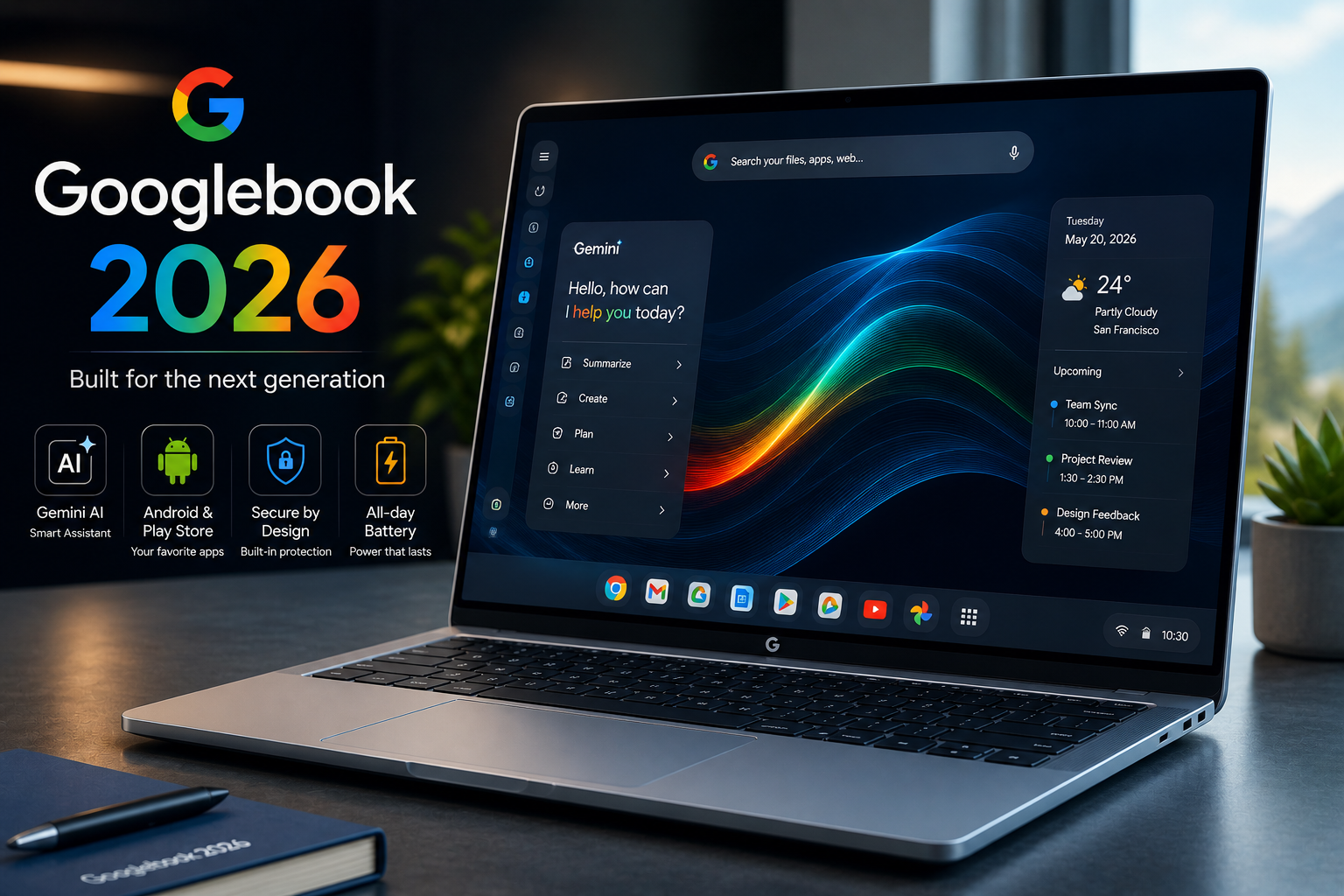
Google has officially introduced Googlebook, a new category of premium laptops designed around Gemini Intelligence. Unlike traditional laptops that simply add AI features through software updates, Googlebook is built around Google’s Android technology stack, desktop foundations from ChromeOS, and deep integration with Gemini. The company says Googlebook is designed to work seamlessly with Android phones, allowing users to move between their phone and laptop more naturally.
Google announced the new Googlebook category on September 21, 2026, with premium hardware developed in partnership with major laptop manufacturers. The initial lineup focuses on different types of users, from people who want a large OLED display to those looking for a lightweight laptop or a flexible convertible design.
What Is Googlebook?
Googlebook is Google’s new premium laptop category. It is designed for users who want a modern computer with built-in Gemini intelligence, strong hardware, Android connectivity, and advanced security.
Google describes Googlebook as its first laptop platform designed specifically for Gemini Intelligence. The devices combine premium materials with modern Intel and Qualcomm processors, 16GB memory, 512GB storage options, and built-in Titan C security.
The idea behind Googlebook is not simply to create another laptop. Google wants the computer to understand the user’s workflow and make everyday tasks easier through features powered by Gemini.
Googlebook 2026 Models
Google has partnered with leading laptop manufacturers to create different Googlebook models. The official Google Store currently highlights three models in its US comparison lineup: Lenovo Googlebook, XPS Googlebook, and Acer Googlebook.
1. Lenovo Googlebook
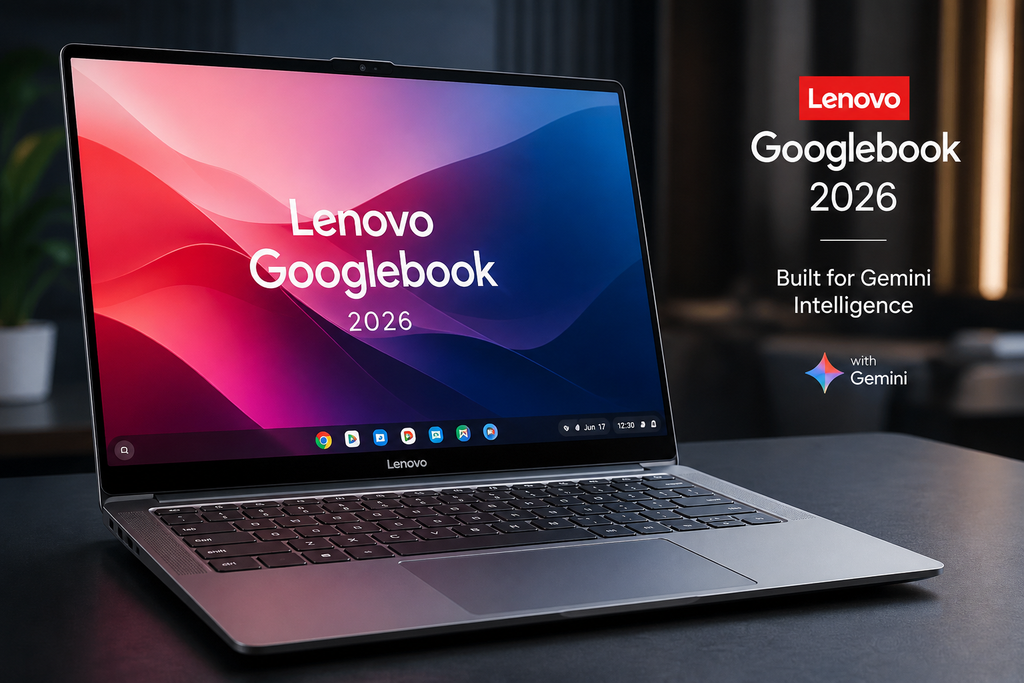
The Lenovo Googlebook is designed for users who want a large screen and a powerful productivity-focused laptop.
It features a 15.3-inch OLED display with a 2880 × 1800 resolution, 120Hz refresh rate, and 100% DCI-P3 coverage. Under the hood, it uses an Intel Core Ultra 5 325 processor with an NPU capable of up to 47 TOPS.
The laptop comes with 16GB of LPDDR5X RAM and 512GB NVMe SSD storage. Google lists battery life of up to 13 hours, while the 70Wh battery can be charged through 65W USB-C.
The Lenovo model also includes Wi-Fi 7, Thunderbolt 4 USB-C ports, HDMI 2.0, a 5MP webcam with a physical shutter, quad speakers with Dolby Atmos, and a glass haptic touchpad.
For security, it includes Google’s Titan C2 security module, fingerprint authentication, facial authentication, and a physical camera shutter. Its weight is around 2.8 pounds.
2. XPS Googlebook
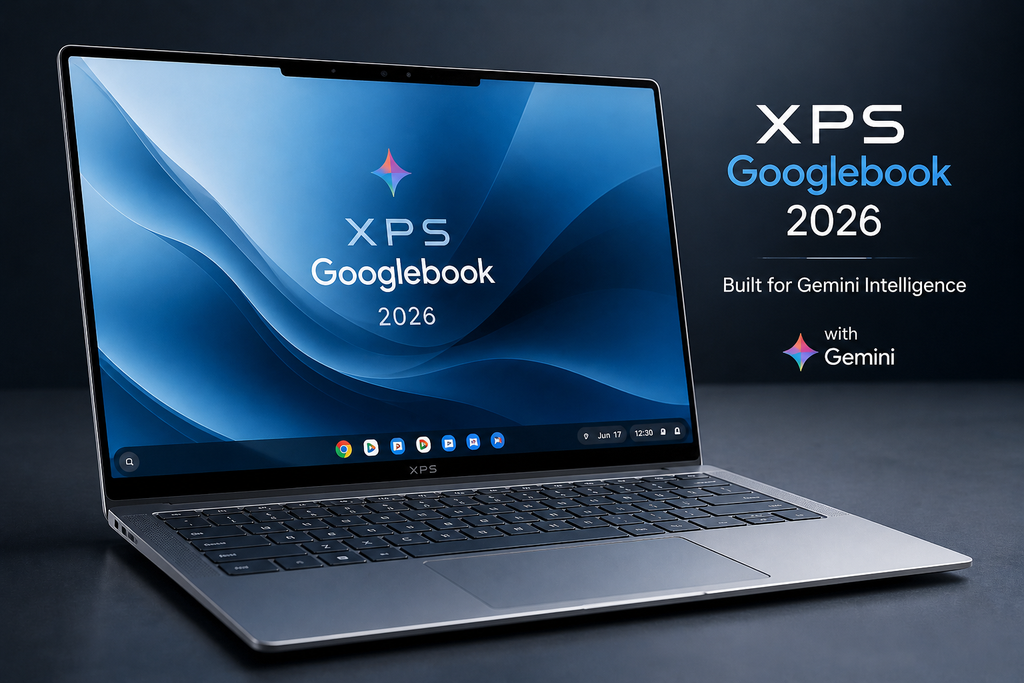
The XPS Googlebook is aimed at people who prioritize portability without giving up premium hardware.
It has a 13.4-inch 16:10 IPS LCD touchscreen with a 2560 × 1600 resolution and a variable refresh rate of up to 120Hz. It uses Qualcomm’s Snapdragon X Elite X1E-80-100 processor and offers an NPU capable of up to 45 TOPS.
The XPS Googlebook comes with 16GB LPDDR5X RAM and 512GB PCIe Gen 4 SSD storage. Google lists battery life of up to 18 hours, making it the longest-rated battery option among the three models currently compared on Google Store.
One of its biggest advantages is its lightweight design. It starts at approximately 2.2 pounds and uses a slim CNC aluminum construction.
The laptop also supports Wi-Fi 7 and Bluetooth 5.4 and includes a fingerprint reader and Titan C security chip. Google lists the XPS Googlebook at $1,199 in the US.
3. Acer Googlebook 14
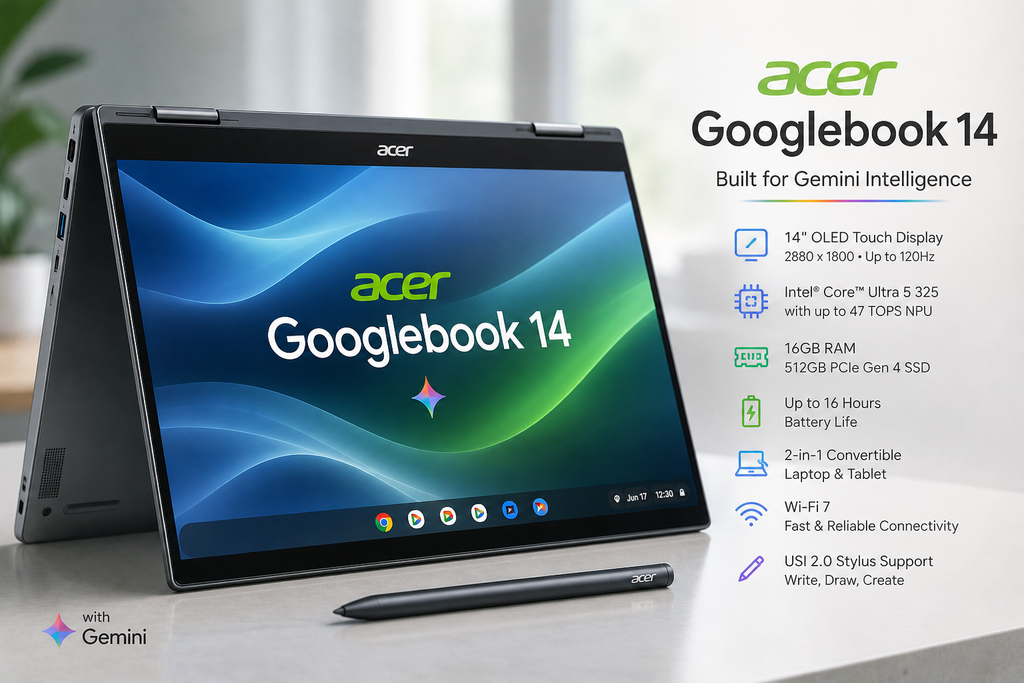
The Acer Googlebook takes a different approach from the traditional clamshell laptops in the lineup. It is a convertible device that can switch between laptop and tablet modes.
It features a 14-inch OLED display with a 2880 × 1800 resolution and up to a 120Hz refresh rate. The screen also supports multi-touch and USI 2.0 stylus input, making the device suitable for drawing, note-taking, and creative work.
The Acer model uses an Intel Core Ultra 5 325 processor with an NPU capable of up to 47 TOPS. It comes with 16GB RAM and 512GB PCIe Gen 4 storage.
Google lists battery life of up to 16 hours for the Acer model. It also supports Wi-Fi 7 and uses a 100W USB-C charging system.
The convertible design is one of the biggest differences between the Acer Googlebook and the Lenovo and XPS models. Users can fold it into different positions depending on whether they are working, watching content, or using a stylus.
More Googlebook Models From Partner Manufacturers
Google’s broader announcement says the initial flagship Googlebook collection includes five distinctive models developed with major laptop manufacturers. Google describes the lineup as covering different needs, from convertible designs to lightweight travel laptops and productivity-focused machines.
The manufacturers mentioned by Google include Acer, ASUS, Dell, HP, and Lenovo. Google has also published regional information showing that the exact lineup can vary by market. For example, Google’s Australian announcement highlights ASUS, Dell, HP, and Lenovo models, while its US store currently highlights Lenovo, XPS, and Acer.
This means buyers should check the Google Store for their country before assuming that every Googlebook model is available in every market.
Gemini Intelligence Built Into Googlebook
One of the biggest features of Googlebook is Gemini integration.Google says Gemini is built directly into the Googlebook experience rather than being treated as a separate application. The system is designed to understand context and help users complete everyday tasks more efficiently.
One highlighted feature is Magic Pointer. With a quick movement of the cursor, Gemini can appear where the user is working and use the surrounding text, images, and context to provide assistance.
Googlebook also includes other AI-focused features designed around voice interaction, productivity, and task assistance.
Android Phone Integration
Googlebook is also designed to work closely with Android smartphones.
Google says users can start tasks on their phone and continue them on the laptop. The platform is designed to make sharing files, streaming apps, and continuing tasks between Android phones and Googlebook more seamless.
For people who already use Android phones, this integration could become one of the most important parts of the Googlebook experience.
Display and Performance
The Googlebook lineup offers different display sizes and hardware configurations.
The Lenovo model focuses on a large 15.3-inch OLED screen, while the XPS Googlebook uses a smaller 13.4-inch display for portability. The Acer Googlebook sits between them with a 14-inch OLED convertible display.
All three models listed by Google Store include 16GB RAM and 512GB storage, while processor choices vary between Intel Core Ultra 5 and Qualcomm Snapdragon X Elite.
Security Features
Security is another major part of the Googlebook platform.
Google has included the Titan C security module in the devices, along with biometric authentication options. Depending on the model, users can unlock their laptop using a fingerprint or facial authentication.
Some models also include a physical camera shutter for additional privacy. Google says the security architecture is designed to protect data, passwords, biometric credentials, and the laptop’s startup process.
Googlebook 2026 Price
Google announced the new Googlebook category with prices starting at $899 in its global announcement. However, the price depends on the specific model and market.
For example, Google currently lists the XPS Googlebook at $1,199 in the US, while the Lenovo Googlebook is listed at $1,349.
Prices and availability can vary between countries, so buyers should check the official Google Store in their region.
Final Thoughts
Googlebook 2026 represents Google’s move into a new generation of premium laptops built around Gemini Intelligence. Instead of focusing only on traditional laptop specifications, Google is combining AI, Android connectivity, premium hardware, and security into a single platform.
The Lenovo Googlebook focuses on a large OLED display and productivity, the XPS Googlebook emphasizes lightweight portability and long battery life, while the Acer Googlebook adds a flexible convertible design.
With additional Googlebook models being developed with manufacturers such as ASUS, Dell, HP, and Lenovo, the lineup is designed to offer different choices for different types of users. As Googlebook expands into more markets, the platform could become an important part of Google’s hardware ecosystem alongside Android and its other devices.
Hashtags
#Googlebook2026 #Googlebook #GoogleLaptop #GooglebookModels #GooglebookFeatures #GoogleGemini #GeminiAI #GoogleAI #AcerGooglebook #LenovoGooglebook #XPSGooglebook #GoogleTechnology #TechNews #Laptop2026 #NewLaptop #Tech2026 #LaptopTechnology #ArtificialIntelligence #TechLogic
Keywords
Googlebook 2026, Googlebook, Googlebook laptop, Google laptop 2026, Googlebook models, Googlebook features, Googlebook specifications, Googlebook price, Googlebook release date, Googlebook 2026 models, Googlebook Gemini AI, Google Gemini laptop, Gemini AI laptop, Google AI laptop, Lenovo Googlebook, Acer Googlebook, XPS Googlebook, Googlebook battery life, Googlebook OLED display, Googlebook performance, Googlebook Android integration, Googlebook security, new Google laptop, latest Google laptop, best Googlebook models, Googlebook technology, Googlebook 2026 specs, Googlebook 2026 price, Googlebook review, Googlebook news